In my last blog I applied the “Handsome Heroes and Vile Villains” by Amy M. Davis to the Disney animated feature The Emperor’s New Groove (2000), so for this extra class blog, I will apply the other reading to another piece of media.
I will start out this blog by admitting that this is a total stretch, but I will be applying Suzanne Williams-Rautiola’s “Animated Fathers: Representations of Masculinity in The Simpsons and King of the Hill” to the Netflix series BoJack Horseman.
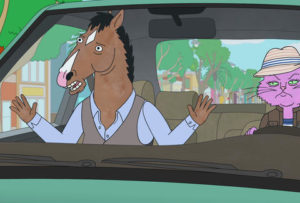
BoJack Horseman (voiced by Will Arnett)
The show BoJack Horseman is about a has-been television star, BoJack Horseman, who starred in a successful 90s sitcom called Horsin’ Around. In the show, he played a surrogate father. The series portrays BoJack Horseman more on the Homer Simpson side of the masculinity continuum, away from the Hank Hill side, as discussed by Williams-Rautiola. That is, BoJack “fails” at masculinity through his baffoonery and by not meeting hegemonic expectations of American society.
The chapter talks about the characterization of masculinity à la Nick Trujillo, whereby “hegemonic masculinity” features the following components: “(1) physical force and control, (2) occupational achievement in an industrialized, capitalistic society, (3) patriarchy, which includes being breadwinners, family protectors, and strong father figures, (4) frontiersmanship, including the daring and romance of the past and outdoorsman of today, and (5) heterosexuality” (96-97).
She goes on to note that Homer Simpson functions in this paradigm of masculinity by following some of these characteristics with the addition of “baffoonish characteristics” where he is “at best, […] benign and inferior, at worst, an embarrassment” (97). Likewise, BoJack Horseman functions in a similar way. However, while Homer exhibits these characteristics to make him function somewhat properly within hegemonic masculinity; in the case of BoJack Horseman, these qualities are what identify him as a “failure.”
In BoJack Horseman, (1) he has no control and doesn’t function successfully as an adult, (2) while he had enjoyed success and fame earlier in his life, in the 90s, he is currently a has-been with no prospects, (3) he played a strong father figure in his fictional sitcom life, but in reality, he is not father-material and can’t even keep a functional relationship due to his financial instability along with his vices, (4) he is absolutely not an outdoorsman, but requires the trappings of modernity and life indoors, in the private sphere, and (5) while he is heterosexual on the show, he doesn’t practice it in any sort of functional manner.
He is made a baffoon constantly in that through his vices or just his inept nature, nothing ever goes his way and he screws up practically every endeavor he attempts. Everyone around him seems more intelligent and capable than he. In the opening scene of the first episode, BoJack is on a talk-show that talks about his past role on Horsin’ Around, Charlie Rose (the host of the talk show) describes the show as being inferior crap but managed to stay on the air for nine seasons (thereby critiquing BoJack’s skill and status as an actor). After Rose intros BoJack by introducing the show and showing some clips, the first words out of BoJack’s mouth are an apology for being late for the show (which further suggests he is incompetent and inept). Finally, when Rose asks him what he’s been up to since the show’s cancellation, BoJack has absolutely nothing to talk about. Later in the show, BoJack is exasperated and asks his Penguin Publishing Agent (the character is a penguin) “why did I say that I could write a book?!” A tension arises with his agent because he’s supposed to be writing his memoirs, but he fails at it and is crippled by his feelings of failure and being a “has-been.”
Thus, BoJack is coded as a failure for not living up to the expectations of hegemonic masculinity.