BLOG 13: HISTORY OF NEW MEDIA IN THE DIGITAL AGE

These last set of readings were on the topic of the history of digital media. Always Already New by Lisa Gitelman provided an interesting perspective by problematizing the ability to conduct a history (or, histories) of new media. She sets up problems with dealing with technology through a discussion of the Hubble space telescope. After the launch of Hubble and after it had reached its desire location in space, NASA did a test and it was discovered that the mirrors were ground incorrectly and the images came back distorted (there’s a great documentary about this and its repair, narrated by Leonardo  DiCaprio). Anyway, Gitelman talks about the fix of Hubble as “need[ing] glasses” (2); she problematizes this as Hubble was glasses in itself, so it’s like the glasses the glasses were wearing. She compares Hubble to glasses in that Hubble didn’t itself see; we (humans) saw what was in space through the technology (lenses) of Hubble.

She also talks about records providing a unique problem, otherwise unheard of until that time, a medium that only machines could read. Carvings, people could read; hand-written word, people could read; typed words of a book, people could read; telephones, people could hear. However, with the phonograph and it’s vinyl record, a person could not “read” a record, a device was required to play the new media object.

In Chapter 4, she talks about problems with conducting historical new media research. Something that I thought was especially intriguing was her analysis of the problems with web histories. In talking about the history of the first mention of “the internet” in The New York Times, she uncovers an error: the search engine will bring up an entry from 1854, even though the internet was not actually discussed in 1854. The entry will pop up because of an error in tagging. The article says “the interest,” but it comes up as “the internet,” thus creating a problem in when “the internet” was first discussed in print. Other errors she discusses are file not found errors, formatting errors, and private vs. public errors.


In Theorizing Digital Cultural Heritage, geographical concerns are discussed. The most interesting analysis provided, to me, is the analysis of place. What is place in a digital world? In talking about place-making in digital contexts, Champion and Dave say, “our idea of place is identifiable as a locus between environmental features and personal or physical preferences” (339).


The last interesting idea brought up from this reading is in “Geo-Storytelling” by Refsland, Tuters, and Cooley, whereby they explore the concept of GPS locators in media. They note, “[l]ocation-aware wireless devices will hypothetically permit an immersive experience in which users will be able to borrow layers of digital information encoded to a particular place” (410), however, they also are quick to note how this same technology can be used nefariously, to track users.
BLOG 12: HISTORY AND TECHNOLOGY (PART 2)

MASTERS OF DOOM (David Kushner)

This reading was surprisingly interesting. Before reading them, I expected to not be interested nor find anything relevant in these two readings, but I was pleasantly proven wrong about that.

The readings from Masters of Doom were very interesting in the way they were written. Throughout the readings for this class, many of the authors have stressed how important it is to remember that historical writing is telling a story. These readings by Kushner tell a story, an interesting story.

I think he does a great job of marrying historical information with storytelling. At times, I wonder where he gets his data from, for example when he’s telling stories from the viewpoint of Romero. He doesn’t mention that he interviewed Romero and he doesn’t state the information as being universal, as things every player sees or hears or experiences. He very much tells the exact response of Romero in these moments (mainly game-play); which leads me to wonder how much liberty he took in those moments.

The most important discovery in this reading is finding a writing style I really enjoy reading. I plan to buy Masters of Doom (and any other books written by David Kushner) to get more acquainted with his writing style.

THE VIDEO GAME EXPLOSION (Mark J.P. Wolf, ed)

First, as a non-gamer, I found the video game timeline before the readings useful. Most of the video games I am aware of were referenced in the timeline. I’m familiar with a few arcade games, like Street Fighter, and the major releases from my childhood, like Super Mario Bros.; so the timeline provided gave me a good contextualization of the field.

I am more and more leaning towards exploring the field of film music, so this article on “Sound in Video Games” by Eric Pidkameny was insightful because a lot of the considerations in video games are also important in film music — diegetic versus diegetic music, the affective nature of music, the narrative qualities of music to tell things that the storyline doesn’t or can’t.

Additionally, as someone interested in various textualities (intertextuality, paratextuality), Martin Picard’s chapter “Video Games ant Their Relationship with Other Media,” was interesting when thinking about adapting video games for other media and the para/intertextuality of video games and film or television.

Blog 12: History and Technology (PART 1)

OFF THE RECORD (David Morton)

These readings focused on recording culture. The “Introduction” provides an overview of the historical development of recording technology. “High Culture, High Fidelity, and the Making of Recordings in the American Record Industry” talks more about the cultural development and acceptance of the recording technology. An interesting part of the introduction is its early emphasis on mechanical recording was not for mass media or entertainment purposes, although a majority of the research is on the music industry and the production of records. The introduction also provided the development of recording technology from Edison’s phonograph, to Smith’s  telegraphone, to wax cylinder recordings, to record discs.

To me, the most interesting section of the introduction is “Recordings, Culture, and the Culture of Recording,” because it provides me with a solid starting off point for a project I have been trying to get started for like a year now. The section discusses records as “cultural artifact[s]” (7) and suggests theorists such as Adorno, Benjamin, Barzun, McLuhan, and Boorstin to understand recording culture. He asks the question: “What, then, was the relationship between music, performance, business, and technology” (7)? Which, is close to the relationship I am interested in between vinyl records, film music, affect, and business/industry.

Chapter 1 talks about the cultural influence on the recording technology. It especially stresses the impact that classical (high culture) music had on the development of technology. Many of the advances in recording equipment and practices had the goal of recording classical music in high fidelity. The chapter goes on to explain how strange this is, considering that popular music (at that time, that meant jazz and swing music) was what was financially successful, as that was the music sold for jukeboxes; whereas classical music only accounted for a fourth of the sales. However, as technology developed, it was always tested and improved with classical music in mind — setting up recording horns for classical orchestras, is one example from the chapter.

The chapter discusses the improvements made to phonograph recording (such as different cylinders and discs to record on, the use of recording horns, and the strength of the material of the recording discs, as well as the adoption of tape recording as the step before the master cut was transferred to disc. The chapter also covers the implementation of multiple recording tracks so elements of the song could be recorded separately — singers from instruments or different sections of instruments in an orchestra.

“THE COLOR OF NITRATE” (Paolo Cherchi Usai)

This chapter talked about different coloring techniques during the silent film era. It opens up using The Lonedale Operator as an example. The key information from this article is understanding the different methods of coloring film in the silent era. They are as follows:

  • Hand coloring – “color was applied directly onto the print” (23).
  • Tinting – “a method of applying color to the surface of the film without alterning the physical structure of the emulsion… the entire picture is colored uniformly, and the area around the perforations is also colored” (25).
  • Toning – featured “a more sophisticated range of color variations…. the print was immersed in a chemical bath that substituted a colored compound for the silver in the emulsion. This dyed only the darker areas of the image, leaving the rest of the gelatin completely transparent” (26).

The chapter ends discussing the importance of film restoration in archives. Usai notes that much of the colored silent film has been lost and that the film only has a lifetime of 100 years. The film becomes sticky and degrades to the point that it is unwatchable and is lost. One of the manuals cited in the section talks about how a black and white print of the film should be made before colorizing it, in order to aid in archiving it.

Blog 11: History of Industrial Practice

FIFTIES TELEVISION (William Boddy)

These readings discussed the challenges television faced to change in the 1950s. One challenge was the duration of programming: 30 minutes versus an hour. Astonishingly, one hour programs were viewed as unviable because people couldn’t be expected to sit in front of their televisions for extended periods of time. Additionally in 1948 a report “endorsed the common belief that programs should be limited to thirty minutes in length” (67). An element that seemed particularly shady in this discussion was said by Bernard Smith in a 1948 issue of Harper’s, saying, “[t]hey will accept a much poorer level of entertainment in their own homes than they will demand if they have to leave their house or apartment to attend a public performance” (68). Thus, suggesting tv should be lower quality than film, a trait that tv has spent a good deal of time overcoming.

Another challenge/debate was whether to bring in film material to television. One reason against this would be that at the time film programming was expensive and this hurdle would need to be overcome in order to use it for television. People also thought that the advertising-format of television was not strong enough to support the expensive process of filmed programming.

Once it was accepted as a viable format in television, filmed content, that is, it was lesser content. Newsweek reported that “everyone who could buy or borrow a little drugstore movie camera announced himself as a TV-Film producer” (71). Even more shocking, CBS was in talks with Lucille Ball about making a television program but the network backed out after Ball insisted on a filmed program.

RUTHLESS CRITICISM (Robert McChesney)

This reading explored the challenges of developing the broadcasting system in the 20s and 30s. Initially, the early system was celebrated. But after broadcast historians such as Erik Barnouw began publishing, this preconception was challenged. McChesney says, “[w]hen historians abandoned the presupposition that a network-dominated, advertising-supported broadcasting system was the only rational choice for a freedom-loving and democratic society, and then scrutinized radio’s early years, a different picture emerged” (222).

Overall, the article leaves me with a feeling of sadness over what broadcasting could have been or should have been versus what it ultimately became. It emphasizes how powerful networks are in broadcasting, very few companies own a majority of the channels/airtime. Which means fewer gatekeepers in content. Fewer people are in the position to decide what content gets aired, thus controls what messages people receive.

“SELLING AMERICA TO THE WORLD” (Peter Miskell)

This article discusses an US-owned film distributer in the UK, United Artists. First, the article acknowledges that the United States’ greatest export is its culture — film and television. US-based production companies began making films to sell to international markets — quota quickies — as a way of gaining more profit. These films were specifically targeted to international audiences and were of less quality than the Hollywood counterparts made for US audiences (the core market). Here, the goal was to make something for moderate costs that would gather moderate success in foreign markets. Miskell notes that the UK audience became the target international audience for US-media products as the cultural gap was closer than that of countries that English wasn’t their national language.

In the end, Miskell notes that after initial success in the 30s, UA began to decline in the 40s. The initial success was due to “hit films” (767) which enjoyed higher box offices than average. Their decline wasn’t so much due to lower production values of these films or the films not being popular with international audiences, Miskell suggests the problem was “[p]ersonality clashes and management failures” (773).

ANIMATION BLOG [EXTRA]: Animated Fathers

In my last blog I applied the “Handsome Heroes and Vile Villains” by Amy M. Davis to the Disney animated feature The Emperor’s New Groove (2000), so for this extra class blog, I will apply the other reading to another piece of media.

I will start out this blog by admitting that this is a total stretch, but I will be applying Suzanne Williams-Rautiola’s “Animated Fathers: Representations of Masculinity in The Simpsons and King of the Hill” to the Netflix series BoJack Horseman.

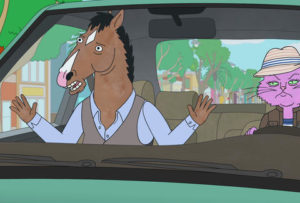
BoJack Horseman (voiced by Will Arnett)


The show BoJack Horseman is about a has-been television star, BoJack Horseman, who starred in a successful 90s sitcom called Horsin’ Around. In the show, he played a surrogate father. The series portrays BoJack Horseman more on the Homer Simpson side of the masculinity continuum, away from the Hank Hill side, as discussed by Williams-Rautiola. That is, BoJack “fails” at masculinity through his baffoonery and by not meeting hegemonic expectations of American society.

The chapter talks about the characterization of masculinity à la Nick Trujillo, whereby “hegemonic masculinity” features the following components: “(1) physical force and control, (2) occupational achievement in an industrialized, capitalistic society, (3) patriarchy, which includes being breadwinners, family protectors, and strong father figures, (4) frontiersmanship, including the daring and romance of the past and outdoorsman of today, and (5) heterosexuality” (96-97).

She goes on to note that Homer Simpson functions in this paradigm of masculinity by following some of these characteristics with the addition of “baffoonish characteristics” where he is “at best, […] benign and inferior, at worst, an embarrassment” (97). Likewise, BoJack Horseman functions in a similar way. However, while Homer exhibits these characteristics to make him function somewhat properly within hegemonic masculinity; in the case of BoJack Horseman, these qualities are what identify him as a “failure.”

In BoJack Horseman, (1) he has no control and doesn’t function successfully as an adult, (2) while he had enjoyed success and fame earlier in his life, in the 90s, he is currently a has-been with no prospects, (3) he played a strong father figure in his fictional sitcom life, but in reality, he is not father-material and can’t even keep a functional relationship due to his financial instability along with his vices, (4) he is absolutely not an outdoorsman, but requires the trappings of modernity and life indoors, in the private sphere, and (5) while he is heterosexual on the show, he doesn’t practice it in any sort of functional manner.

He is made a baffoon constantly in that through his vices or just his inept nature, nothing ever goes his way and he screws up practically every endeavor he attempts. Everyone around him seems more intelligent and capable than he. In the opening scene of the first episode, BoJack is on a talk-show that talks about his past role on Horsin’ Around, Charlie Rose (the host of the talk show) describes the show as being inferior crap but managed to stay on the air for nine seasons (thereby critiquing BoJack’s skill and status as an actor). After Rose intros BoJack by introducing the show and showing some clips, the first words out of BoJack’s mouth are an apology for being late for the show (which further suggests he is incompetent and inept). Finally, when Rose asks him what he’s been up to since the show’s cancellation, BoJack has absolutely nothing to talk about. Later in the show, BoJack is exasperated and asks his Penguin Publishing Agent (the character is a penguin) “why did I say that I could write a book?!” A tension arises with his agent because he’s supposed to be writing his memoirs, but he fails at it and is crippled by his feelings of failure and being a “has-been.”

Thus, BoJack is coded as a failure for not living up to the expectations of hegemonic masculinity.

BLOG 10: THE AUDIENCE IN MEDIA HISTORY

Obviously, these readings follow the topic of the week, the audience; as such, they focus on ratings, uses and gratifications, and reception.

To me, an interesting facet of this set of readings is how the Richard Butsch reading acts as a bridge between the other two.

It does this in three ways:

  1. By discussing the gendered-viewing of media
  2. By discussing the transformation of media technologies into home furniture
  3. By discussing how the audience becomes a commodity to be “sold” to advertisers

The first point, the gendered-viewing of media, really angered me as I was reading the two readings that dealt significantly in the topic; that is, the Butsch reading on radio and Lynn Spigel’s reading on television. I think anything that shows the objectification or promotes the submission of women right now in the political climate we are currently in is like rubbing salt on an open wound. In the Trump-Era, it’s hard to hear about the objectification and completely neglecting or overlooking women as valid people. But, I digress.

The Butsch reading talks about radio and how men became threatened when radio became user-friendly for everyone. They felt as if their masculinity took a hit when radio magazines began “talking to” or catering to a female audience and when radio sets were being sold in complete sets instead of by individual parts that needed to be put together. Radio magazines that were welcoming to women, by running articles to the female audience, soon began objectifying women — switching from considering women as audience members to bait for the male audience members/readership. I find it astonishing that men could have been so insecure and sensitive that opening radio to everyone could have been perceived as threatening.

The Spigel reading likewise talks about the gendered-viewing of television; however, never suggesting it as being a threat to manhood or masculinity. She talks about how televisions were “sold” to women; by appealing to their affinity to nature and as a piece of home decor.

With that said, both the Butsch and Spigel readings discuss radio and television sets in terms of how they became parts of home decor. This part was particularly fascinating to me. Butsch talks about how after the novelty of radio wore off, women wanted a more aesthetically pleasing radio, that is, one complete set that didn’t feature wires going off in multiple directions. While, Spigel talks about how once television sets were a benefit to a home, eventually they became something people wanted to render invisible, so much so they they didn’t even want them near windows.

An additional interesting aspect of the Spigel reading is the discussion of television in terms of architectural moments. First she talks about the television’s purpose in suburbia; that is, bringing the world into the suburban home. Later, she talks about the modernist movement, which sought “the erasure between public and private space” (8).  After WWII, Spigel says people wanted to “merge” the private and public spheres by having open floor plans which featured “large picture windows,” “glass walls,” or “continuous dining areas” (9). In this vein, during this time, televisions were “placed in rooms with panoramic window views, or else installed next to globes and colorful maps” (9).  Later, she talks about how people wanted to hide them, keeping them away from windows or hiding them behind large venetian blinds.

The third theme that bridges the readings is that the audience becomes a commodity to be “sold” to advertisers, bridging the Butsch reading with Stavitsky reading.

The Stavitsky reading is all about the social scientific research regarding audience ratings. The article, overall, paints a very gloomy picture around the field of audience research by discussing how it is driven by economic interests. He talks about how the majority of this research was done for economic reasons (what shows to put on the air, at what times, what should get funded, etc.) or social reasons which leads to political interests, such as the research about educational television.

The Butsch reading discusses how audience research was important to know how to sell things to those listening to the available programming. These marketing tactics applied to radio sets themselves as well as products from program advertisers.

The last thing that stood out to me worth mentioning was in Spigel’s chapter; when she talks about the direct objectification of women. I found the women’s tension with television as the object of male gaze problematic because it suggests that women are no more than an object to be looked at, in real life, not just in the cinema as Laura Mulvey suggested. The most upsetting aspect was the discussion about women changing the television channels and how tuning knobs needed to be moved to the top instead of the bottom of the set because it was unattractive to watch her change channels otherwise, as if wives were private Vanna Whites who needed to conduct these simple tasks with unnatural grace and beauty. The entire section described women not as people but as objects; as the chapter was written by a woman, I find her non-critical view/discussion of this unacceptable.

ANIMATION BLOG 8: MASCULINITY [Father, Bad Boys, Evil Villains]

In “Dashing Heroes,” Amy M. Davis talks about the various types of characters male heroes play in Disney animated movies. One such character type is the frenemies; which is what I want to talk about in this blog. Here, Davis says that frenemies are “heroes who find themselves thrown together, linked by a common love interest (which makes them rivals) or a common goal” (130). In the chapter, she talks about three sets of frenemies, including Ichabod Crane and Brom Bones, Quasimodo and Phoebus, and Wreck-it-Ralph and Fix-it-Felix.

The frenemies pair I would like to talk about is Kuzco and Pacha from The Emperor’s New Groove (2000). While these two are not driven apart because they love the same women (Pacha is married and has a family in the movie, while Kuzco is characterized as being incapable of loving anyone but himself), they find themselves working towards a common goal.

Kuzco and Pacha in The Emperor’s New Groove

At the beginning of the film, the pair are established as adversaries. Kuzco indicates to Pacha that he intends to destroy Pacha’s family’s home in order to build a pool and waterslide for himself in a palace he’s calling Kuzco-Topia. Kuzco, being a mean and rotten emperor, gets turned into a llama by his power-hungry and evil advisor, Yzma.

After being turned into a llama, Kuzco finds himself on Pacha’s cart and demands that Pacha take him back to his palace. Pacha does so only when Kuzco agrees that if he helps Kuzco, he will build Kuzco-Topia somewhere else and save Pacha’s land. Kuzco agrees, although completely intending on doing what he wants after getting back to the palace, which means not following through on the deal with Pacha.

However, through their pseudo-alliance, they find themselves with a common adversary, Yzma, and the pair end up bonding throughout the course of the film. At the end of the film, Kuzco becomes more in touch with his humanity and becomes a better person through his friendship with Pacha, and Pacha comes to understand Kuzco. After returning to the palace and after being restored to his human status, Kuzco does honor his agreement with Pacha, and builds Kuzco-Topia on a nearby hill, leaving Pacha’s home untouched.

This pair breaks the chapter’s goals of considering non-aristocratic characters (as Kuzco is an emperor), however the frenemy character type shows up in this film regardless and both characters are changed by their relationship [friendship] with each other.

ANIMATION BLOG [EXTRA]: Folly, Fools, and Fantastic Mr. Fox

After watching  Fantastic Mr. Fox in class, I am having trouble picking just one fool. I believe both Ash and Kristofferson are fools in the vein of Valerie Palmer-Mehta’s article “The Wisdom of Folly: Disrupting Masculinity in King of the Hill.”

A Case for Ash

Ash (fox on the far left)

Ash is the same kind of fool and following practically the same line of examples as Bobby in King of the Hill. Palmer-Mehta sets Bobby up as a fool because he challenges the hegemony of the show and challenges traditional expectations. The examples from the article cite athletic ‘weaknesses’ or ‘abnormalities.’

Well, Ash has similar abnormalities as Bobby. He’s not athletic. He isn’t as good as his father at the game they play in gym class and he isn’t invited to steal chickens with his family. He is odd and strange because additionally, he wears a cape and spits when he’s upset.

Another way to think about this is that Ash is voiced by Jason Schwartzman, whom is always abnormal and challenges dominant culture or hegemonic ideology in his roles (especially in Wes Anderson films).

A Case for Kristofferson

Kristofferson in Fantastic Mr. Fox

He, like Ash and Bobby, defies expectations. He is called tall, which makes him weird and strange, when comparing him to the other foxes. Also, unlike Ash, he is athletic and is invited to steal chickens and cider with Mr. Fox.

However, this is where it gets tricky. He is unlike the others because he is actually gifted. Ash is seemingly bad at anything physical in nature; while Mr. Fox is bad because he frequently gets caught in his attempt to steal. This Kristofferson’s ability or natural skill, makes him different than the others and thus strange.

In both cases, Ash and Kristofferson, I believe they are natural fools, in that they “genuinely exhibit some type of deficiency or abnormality” (185). And they both break the dominant characteristics of those around them and challenge normality. Thus, to me, both characters could be considered fools.

ANIMATION BLOG 7: GENDER [MASCULINITY]

As I was reading “Post-Princess Models of Gender: The New Man in Disney/Pixar” by Ken Gillam and Shannon R. Wooden, I couldn’t help but think of the movie Wall-E. Gillam and Wooden suggest that Pixar movies, with their male protagonists, redefine masculinity via three maneuvers: emasculating the male protagonist, providing the male protagonist with a homosocial relationship/interaction, and then having the protagonist assume his new status as a “new man.”

Wall-E, the robot, goes through this same trajectory in his film. First, Wall-E is established as an alpha male, much like Gillaim and Wooden track Lightning McQueen in Cars. Wall-E is introduced as masculine at the beginning of the film through showing his determination as he conducts his garbage collecting work. He is shown as being fast, efficient, and tenacious.

Wall-E stacks his compacted garbage cubes

Very soon, he experiences what Gillam and Wooden call the “emasculation of the alpha male” (3). As Wall-E is going about his trash collecting and compacting activities, a new being arrives on his desolate planet, and this new being, the female robot Eve, turns out to be magnitudes more aggressive than he is. Eve has lasers and attacks anything on sight, no questions asked. She is newer, sleeker, and more powerful than he is. She is new and modern, while he is obsolete and falling apart. He keeps spare parts in case he needs a replacement, within his personal collection (or horde) in his home.

He is emasculated not only through Eve’s status as being better and newer than he is, but by his loneliness. He begins the film as the only being on the planet. He has nothing in his life but his work and the objects that he collects that helps him pass the time. When Eve arrives, he sees the potential for companionship.

Wall-E has his own form of homosocial interaction. While not the homoerotic subtext of Mr. Incredible in The Incredibles, Wall-E’s instance of homosociality is his affinity for a musical. He finds comfort in the musical Hello, Dolly! frequently throughout the movie, with a particular attachment to the song “Put On Your Sunday Clothes.” In our homophobic and heteronormative culture, things like musicals and musical theater are associated with gay culture, so his attachment to this musical and this song further emasculates him. But, like Gillam and Wooden suggest in the article, his relationship with this song guides him towards his assuming a role as a “new man.” Gillam and Wooden say that “the intimacy emerging ‘between men’ is constructed through an overt and shared desire for a feminized object” (6).

Wall-E learns about love by watching Hello, Dolly!

By watching Hello, Dolly! over and over again, Wall-E learns about the importance of companionship, affection, and love. It teaches him socialization skills, such that he knows how to act when Eve arrives.

Finally, Wall-E fulfills the cycle described by Gillam and Wooden when he sacrifices himself at the end for Eve, exhibiting what Gillam and Wooden call an “express[ion of] care-taking, nurturing love, and a surrender to the good of the beloved” (6).

Thus, the film Wall-E becomes another example of Pixar’s mission of redefining masculinity, allowing children to see another path, another way to be, as opposed to the stereotypical alpha male, which has become problematized in today’s #MeToo culture.

BLOG 9: Film History

NAZIMOVA’S VEILS (Patricia White)

I started thinking about readings in the terms of ‘what kind of history is this telling?’ In the case of Patricia White’s chapter, it is approaching history from a biographical as well as industrial lens. Biographically, she details the life and career of Alla Nazimova. White obviously concentrates on Nazimova’s portrayal and involvement in the production of Salome, however she also talks about Nazimova as a person and actress. So, a major point of analysis in the chapter is Nazimova’s queering of Salome. Many film critics cited in the chapter talk about the weirdness of her production of Salome due to casting gay actors as well as her own identity as a lesbian. As a person, they discuss her in terms of orientalism, talking about her conflicting identities of being Jewish and Russian. Industrial-wise, White talks about Nazimova’s career as an actress and director. She also talks about Nazimova’s Salome in contrast to other productions of Salome. Finally, she talks about Nazimova’s Salome in terms of film history and film reception; noting that it wasn’t accepted as a hollywood film, but it could be appreciated as an avante-garde film.

MANHATTAN NICKELODEONS (Ben Singer)

This article was interesting to me because it talked about socio-economic research in film history. This article questioned the two common paths for understanding nickelodeon theaters. The traditional view was that only lower-income people attended movies because white collar and the more affluent were above going to the movies; while the revisionist view claimed that the middle class frequently attended movies. Singer’s article really shows what a complex question this is. I like that he approached his historical analysis transparently; that is to say, he was constantly revealing the caveats to any of his questionable findings. The key findings of the chapter are as follows: “The nickelodeon boom” wasn’t as much of a boom as commonly thought. In fact, many theaters failed. Singer suggests that nickelodeons had about a 50% chance of surviving the first year. He also questions the idea of a primarily middle class audience, if not completely obliterates it. Previous research was based on the analysis of four locations in Manhattan; which turned out to not be as middle-class as previous reports suggested. Many were working class neighborhoods with “lower white collar” workers, where white collar workers existed at all. He also found that the placement of nickelodeon theaters had to do with population density more than any other factor. They were located in populated areas with high foot traffic. The chapter does a great job at showing that this research question is not straight forward and requires extensive analysis of population data and business records.

CINEMA AND WIRELESS IN TURN OF THE CENTURY POPULAR IMAGINATION (William Boddy)

This article tackles the comparisons as well as contrasts between media in terms of research and reception. Most importantly, the article emphasizes the idea that a medium doesn’t all of a sudden pop up from no where. There are precursors and technological advances that lead to the big ones. For example, television rose from radio and photography. An interesting challenge Boddy brings up, that I hadn’t considered before was that cinema comes from a more privileged position due to the wealth of primary sources; while with early radio, recordings just don’t exist. Some of the readings from a few weeks ago that dealt with radio got me thinking and wondering why radio isn’t as researched; this chapter explained that question for me. In part, it’s a data issue.


“BEFORE SHE WAS A VIRGIN…” DORIS DAY AND THE DECLINE OF FEMALE FILM COMEDY IN THE 1950s AND 1960s (Dennis Bingham)

This article is interesting for two key reasons. First, I find it interesting the Doris Day herself dismantled her own image, by penning an autobiography to set the record straight. The autobiography tarnished her good girl, pure image and in it, she critiqued her own movies. Second, it is interesting by establishing her role in comedy. The article says that in her films she is considered a comedian or a funny woman, yet she delivers her funny lines straight and it is often the men around her who are funny, telling jokes at her expense.

VAUDEVILLE: THE INCARNATION, TRANSFORMATION, AND RESILIENCE OF AN ENTERTAINMENT FORM (JoAnne Stober)

In this book chapter, Stober discusses the history of vaudeville. She talks about the changes vaudeville experienced as an industry and art form, trying to legitimize itself and bring in higher clientele or more affluent audiences. However, what I found the most interesting was its connections with cinema. First, I found it interesting that vaudeville and cinema were linked as joint programs. And then, I was surprised to see that the coming of sound cinema is what brought the decline of vaudeville as “[t]he adoption of an all-filmic program meant that the live character once lent to the exhibition was vanquished, therefore rendering exhibition practices and programs seamless and homogenous from milieu to milieu and city to city” (143).