COLOR THEM BLACK (Adilifu Nama)
Nama makes two very important key points near the beginning of the article. The first of the key points occurs when Nama’s talking about the author Junot Diaz’s childhood identification with Marvel’s The X-Men. Nama says, “because the group were mutants and were treated as social outcasts, as a young Dominican immigrant, Diaz felt an affinity for the characters due to his own marginalized racial status that stigmatized him as an outsider to mainstream America. Diaz’s experience speaks to the power of superheroes to deliver ideas about American race relations that stand outside of strict notions of authorial intent and draconian concerns about white superheroes (or black ones, for that matter) depositing negative notions about one’s racial identity into the reader or viewer” (pages aren’t marked, page 3 of the chapter). This speaks to me personally, not about race (so I won’t talk about it very long, as I understand this week is about race), because I, myself have an affinity for a comic book character because of parallels between the comic book (/film) representations and my real life. I have an extreme affinity for and empathy for the Marvel villain Loki. In the MCU, Loki is adopted and has a complex and problematic relationship with his family. I am adopted and have an extremely problematic relationship with one side of my family (stemming from my being adopted, actually). It’s important that Nama notes that feeling marginalized or otherwise Othered in some way in your real life can lead to negative identifications with fictional characters in the media consumed.
Secondly, of the 60s and 70s, Nama says, “[d]uring this period the bright line between the popular and the political was obliterated as American pop culture began to shred its escapist impulses and boldly engage the racial tensions that America was experiencing. For example, James Brown’s song ‘Say it Loud, I’m Black and I’m Proud (1968) did double duty as a dance hit and a racial anthem of uplift and self-esteem” (again, pages aren’t marked, but still on page 3 of the chapter). I believe this spirit cycled around with the release of Black Panther (Ryan Coogler, 2018), which is my chosen media for this week.
Here’s the trailer on YouTube: https://www.youtube.com/watch?v=xjDjIWPwcPU
I say this because with it, Marvel didn’t simply tell the same old origin story, as it is accused of doing in many of they’re movies; but it turned to politics. Black Panther is about race, it’s about colonialism, it’s about cultural appropriation — it is a complex movie about many political topics. This is relevant to a class on animation because Black Panther started as a comic, and does have many animated aspects in the film as well, although largely filmed as live-action.
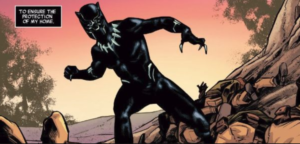
Ultimately, it comes back around to representation. It is important for everyone to find images in media that they can positively and realistically identify with. Representations that are not built upon negative stereotypes that harm the communities that are being represented. Also, these comics (and film adaptations) provide a counter-cultural subversion that pushes back against systematic racism in order to offer a stronger element of social justice.
BLACKNESS, BAYOUS and GUMBO (SARAH E. TURNER)*
Was discussed in my previous blog post.