Monthly Archives: January 2019

Proto-Cinema Blog 5: Pictorial Language Creative Process

In class we were asked to create a language that speaks to who we are; naturally, I thought I might make a horror alphabet. I decided I was going to draw symbols for a horror movie representing every letter of the alphabet.

A – Arachnopobia

B – Blair Witch Project, The

C – Children of the Corn

D – Dreamcatcher

E – Exorcist

F – Friday the 13td

G – Gremlins

H – Halloween

I- It

J – Jaws

K – Krampus

L – Leprechaun

M- Mummy, The

N – Nosferatu

O – Ouija

P – Psycho

Q – Quarantine

R – Ring, The

S – Scream

T – Thing, The

U – Uninvited

V – Vertigo

W- White Noise

X – X: The Man with X-Ray Eyes

Y- Young Frankenstein

Z- Zombieland


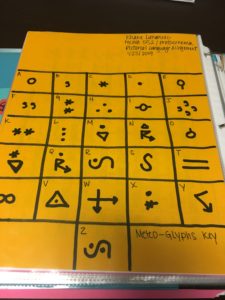
Then, I thought, maybe I could start a theme. I did an eclipse for the cave painting assignment, I could do something related to science for this project. So, I decided to create an alphabet from meteorological symbols.

[Pic: Examples of the most commonly used meteorological symbols]


So, I randomly assigned symbols to letters and created “meteo-glyphs.”

Proto-Cinema Blog 4: Cabinets of Curiosity

What I love about this article from Jan Svankmajer, “Cabinets of Wonder: On Creating and Collecting,” is that what he’s attempting to describe cannot be described. He’s attempting to describe the indescribable. At the end, he discusses his own cabinet of wonder, containing naturalia, exotica, esoterica, artecicialia, scientica, Gaudia, Funeralia, horribilia, and vetustissima. His collection somehow collects representations of all these abstract ideas.

I love Svankmajer’s films. They have this oddity about them. The thing I can’t help but think about is the way these directors who see the world differently than the rest of us, all tend to be collectors, creating their own cabinets of wonder and curiosity — Guillermo del Toro is another. He calls it “Bleak House” and it’s fantastically strange.

[Pic: Guillermo del Toro in the cabinet of curiosity that he calls home]

The beginning of the article also speaks to me, as a collector. I’m without a doubt a collector of horror, superhero, and nerd culture oddities. A particular idea that resinates with me greatly is when Svankmajer says, “I’m basically passive. The objects of my desire seek me out, not I them.” I feel similarly.

As a last thought, I’m left with this idea what “cabinets of wonder initiates us. After leaving we are transformed.” What a tall order that is, indeed.


[Edit: Additional content from the initial post found below.]

I just saw a second reading was posted, so let me briefly talk about it as well.

Something that stands out about Melody Amsel-Arieli’s “Cabinets of Curiosity,” occurs on page 41. She says, “since they considered all forms, factual or mythical, part of Man’s sum of knowledge, each object held equal importance.” This is incredibly striking and relevant to me because it adds to multiple conversations I’ve had in classes this week about the value of research. I love that in these cabinets mermaid’s heads were equally regarded as plants, animals, or minerals. In one of my seminar classes this week, well actually in two of them now that I’m thinking about it, we talked about the divide between social science and humanities researchers and how each group thinks they are the one true research path and the other is hokum. While in these cabinets, everything is on equal terms, as should research be, in my opinion.

Another thing that spoke to me about this article was, also on page 41, where she talks about these rooms of wonder and how people would buy tickets to look at the oddities. Perhaps, P. T. Barnum wasn’t the first to profit on spectacle, perhaps it was these curators of wonder and curiosity.


Proto-Cinema Blog 3: Cave Painting Creative Process

For this assignment I went through a several ideas.

First idea: I wanted to do an interpretation on a modern day cave painting. So, I thought this would probably be something like bathroom graffiti or high school locker art. Both had challenges I couldn’t figure out how to overcome by the assignment date.

Second idea: I was going to create a traditional-looking cave painting or petroglyph on red rocks, a la Colorado’s Fountain Formation (sandstone). I bought paints and drew on a styrofoam circle, but something about it didn’t seem right

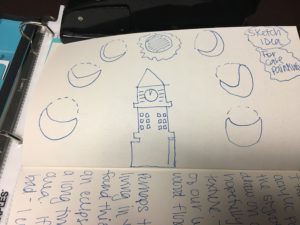
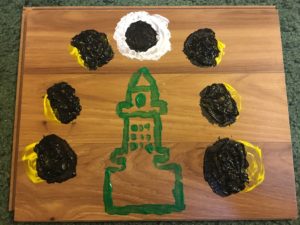
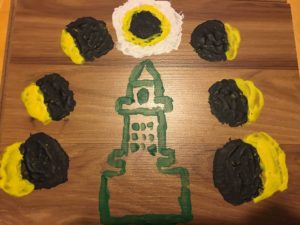
Third (and final) idea: I decided to go back to the modern day cave painting. Ultimately, I have decided on something that’s a mix between modern day and traditional. I drew my cave painting on a piece of leftover laminate flooring. It depicts the 2018 eclipse over SIU. {Pretty sure a five year old could draw something more artistic than this, but it’s the best I can do… I’m so not artistic.}

I think my “story” is going to be that when going through an archive of old artifacts from the University that used to be here {we’re living in the future in this scenario} I found this painting of the 2018 eclipse, that passed over the campus.

Here’s my initial sketch:

Here’s the project about half-way done (includes a couple layers of paint):

Here’s the final product (with the included yellow ring around the eclipsed sun):

Proto-Cinema Blog 2: Hieroglyphs

The first reading, “What the Heck is Cuneiform, Anyway?” by Anne Trubek was a fascinating read for two reasons: 1) Before reading it, the only thing I knew about cuneiform was that it was symbols drawn on clay stones/tablets and 2) the article offers an interesting parallel between cuneiform and current media technology. One of the interesting things I learned in the article was how the cuneiform code was cracked (translated). I am now curious about this tendency to offer language decoders in threes. Trubek compares the cuneiform translation discovery to the discovery of the Rosetta Stone; the cuneiform translation featured the same writing in Persian, Elamite, and Babylonian, while the Rosetta stone had the same text in hieroglyphics, demotic, and Greek. This similarity intrigues me very much. I’m also intrigued by the two comparisons Trubek makes between cuneiform and iPhones. First, she says that cuneiform is often found on clay iPhone sized tablets; later, she compares cuneiform tablets to iPhones in that they are both “cool, hard, palm-sized tablets onto which receipts, notes, messages, and even great works of literature are written and read.”

The second two readings–“A Note on the Hieroglyphs [unknown] and [unknown]” by Ludwig Keimer and “Deciphering Maya Glyphs” in ushistory.org–discuss controversies or discoveries made by analyzing Egyptian hieroglyphics and Mayan Glyphs. The Keimer article corrects mistaken assumptions about two hieroglyphics and their meaning (and the birds they are thought to represent). The interesting maneuver that Keimer makes is considering the migratory patterns of birds in the analysis of the meaning of glyphs depicting birds. While the ushistory.org article describes horrific colonization (whereby the colonizers destroyed the artifacts of the colonized (Mayans)). It also describes the altered history uncovered in translating Mayan stone tablet carvings. These translations challenge the old belief that the Mayans were peaceful and replaced these ideas with accounts of war and conflict.

***

Comments about creative process for cave painting assignment:

I forgot to mention in my last blog that I have painted over a styrofoam circle (used for floral arrangements and crafty things) in red in order to pretend it is a discovery from Colorado (red rocks). I haven’t decided if I’m going to do a cave painting or a petroglyph on it.

Comments about creative process for hieroglyphs assignment:

None yet. We haven’t been assigned this project yet.

Proto-Cinema Blog 1: Cave Paintings

The first two readings—“Cave Paintings Change Ideas About the Origin of Art” by Pallab Ghosh and “Were the First Artists Mostly Women?” by Virgina Hughes are great because they break the commonly-held assumptions about cave paintings. If you would have asked me at the beginning of the first class what I thought the function of cave paintings were and who drew them; I would have said that I thought cave paintings were an early method of record-keeping, performed by men. This is the case, mainly because most of the cave paintings I have seen in museums and textbooks have been either of humans or large animals that hunters presumably killed for food.

What’s great about these readings is they not only challenge dominantly held beliefs propagated by colonialism (art and science are European advances; as in Ghosh) and patriarchal society (men created them; as in Hughes) by proposing that art (cave paintings) were created across the world at around the same time (Ghosh) and most of the cave paintings were done by women (up to three-fourths of them says Hughes).

Another interesting thing that these articles suggest is that cave paintings weren’t necessarily strictly record keeping. In fact, they were most likely artistic or magical in nature. The conflicting viewpoints are discussed in the Hughes reading, but while multiple hypotheses are being debated over cave paintings, who drew them, and what their purpose was, a multitude of histories are being discussed that extend well beyond the erroneous patriarchal colonialism viewpoint that excludes the potential for different groups of artists and the creation of art for multiple purposes.

Additionally, I got a kick out of the Cowing article about the ESA Solar Probe because before I switched to media, I studied meteorology/climate and during that time, I participated in a REU (Research Experience for Undergraduates) at the Laboratory for Atmospheric and Space Physics in Boulder, CO, whereby I conducted research in Space Weather, looking at solar physics data sets, with information gathered from solar satellites. Cowing’s article talked about the material/coating called “Solar Black” (which is black calcium phosphate), I got to see the application of Solar Black to space satellite components in one of LASP’s clean rooms during the summer I spent at the research center. So for me, this fun article provides an interesting collision of worlds for me.

***

Comments about my creative process for the cave painting assignment:

So, I have been doing a lot of thinking about what “modern day cave paintings” would be, where they would be found, etc. I have three initial ideas of what I could do. Modern day cave paintings could be bathroom stall art/graffiti, high school locker art, or even picture-based games like Pictionary.

There are some problems with operationalizing these ideas for this project. My main challenge is access. I don’t have access to high school lockers (and I looked into buying a mini locker, less than 3 feet tall, but it wouldn’t be delivered until after the assignment due date) and there aren’t many places I could legally draw on bathroom stalls (I thought about Hangar 9, but that’s hardly original based upon the prolific bathroom graffiti there). I thought I could use dry erase markers on stalls. Do the art, take pictures, and safely wipe the art away; but again, I’m not convinced it’s the most inspired project. I do, however, feel that both of these endeavors would encapsulate the same kind of inspiration as cave paintings; a way to say “I was here and this was my experience.”

The Pictionary idea intrigues me as it does offer visual communication for artistic or entertainment purposes. But, again, I’m not sure it’s too terribly original. I have the game Pictionary-Man that I could play around with. It’s basically a white board shaped person that you can draw on.

When I lived in CO, I had a friend who obsessively went hiking in search of petroglyphs. These rock carvings intrigue me a great deal and I vicariously participated in his hikes and shared his obsession through the pictures he shared on Facebook to document his discoveries. I’m intrigued by creating some petroglyphs as my project; obviously I am still in the brainstorming phase of this project.