In “Starlets, Subscribers, and Beneficiaries: Disney, Latino Children, and Television Labor” Christopher Chávez and Aleah Kiley discuss latino/latina representation in Disney media properties. When thinking about the Disney animated feature Coco (Lee Unkrich, 2017) a few of their observations become extremely relevant. They are:
- “Latinos have not been adequately represented either in front of or behind the screen” (2618).
- “Latino representations on television are produced by large conglomerates with little equity in the Latino community. At best, these networks may develop programming with hired Latino help. At worst, they are creating programming with the help of producers who have little or no knowledge of Latino culture” (2618).
- “Disney’s representation of Latinos and children of color from essentialized stereotypes to ambiguous hybridity. The new racially hybrid characters promote recognition for progressive inclusion while erasing serious realities about U.S. racial inequalities” (2619).
To address the first point: Although there are countless animated films (including those by Disney, perhaps especially including those by Disney), a majority of them focus on white, American characters. Few films focus on hispanic ones. Recently, only three examples come to mind, Coco, The Book of Life (Jorge R. Gutiérrez, 2014), and Turbo (David Soren, 2013). Of the three, only is The Book is Life directed by a latino animator; the other two are white men: Lee Unkrich is from Ohio and David Soren is Canadian.
The second point discusses that the companies who make these films and television shows are not from the communities they are trying to represent and thus take no steps to create a faithful cultural representation. In “Saludos Amigos and The Three Caballeros: The Representation of Latin America in Disney’s ‘Good Neighbor’ Films,” Karen S. Goldman talks about Disney creating representations of Latin America that exhibit inaccuracy. She observes, “while Saludos Amigos and The Three Caballeros were commissioned, in part, to dispel negative stereotyping of Latin Americans in Hollywood cinema, lose analysis reveals that the films actually promote other, no less inaccurate stereotypes, and, in particular, underscore the longstanding unequal relationship between the U.S. and Latin America. They continue to depict the flow of cultural texts from north to south as natural and unequivocal” (25).
Within Coco, contradictory readings can be found. First and most obviously, it appears to be a celebration of Mexican culture. The film opens to introduce the audience to Coco’s family. A likable family that seems realistic, close-knit, and loving. The film introduces us to Mexican culture, including the Day of the Dead, Mexican music, art, beliefs, and value systems. They are a hard-working family of shoemakers. This pushes back against the harmful stereotype that Mexicans are lazy and criminals.
However, although the film welcomes us into this enticing world filled with a good, caring family; it certainly acts to Other the characters. The mythology and customs of the Day of the Dead take on extreme supernatural qualities. It deals with many of the real life customs, as described in Jan Thompson’s documentary film, Food for the Ancestors (1999), about the food customs around the holiday. However, Coco makes these beliefs and customs fantastical, which suggests that Mexicans are primitive people who subscribe to new age belief systems, beyond the rational world.To address the third point: Coco hybridizes its main character, Miguel. When he enters the land of the dead in order to find who he believes to be his ancestor, Hèctor (who amusingly enough is his actual great-grandfather) paints his face so that he looks more like a skeleton, allowing him to fit in. However, this act could also be read as making him appear more white and more Anglo-American. Hèctor paints Miguel’s face white with black rings around his eyes to make him look like a skeleton — or to make him white, and appealing to more audiences. Because, at this point, we have been introduced to him as a latino character in his own culture (this grabs the latino/a audience); by converting him to a white character, it then allows the white children to also identify with him and his quest.
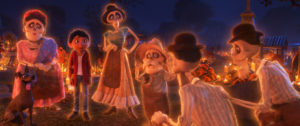
Miguel before his face is painted

After his face is painted
Coco, then, tries very hard to respect Mexican culture, representation, and talent — through its depictions and people involved in the project (production and talent). However, it still finds ways to reach out and include the white, American audience because at the end of the day, Disney/Pixar are companies out to make money and the more people you can reach, the more profit at the box office.