Monthly Archives: October 2018

ANIMATION BLOG 8: MASCULINITY [Father, Bad Boys, Evil Villains]

In “Dashing Heroes,” Amy M. Davis talks about the various types of characters male heroes play in Disney animated movies. One such character type is the frenemies; which is what I want to talk about in this blog. Here, Davis says that frenemies are “heroes who find themselves thrown together, linked by a common love interest (which makes them rivals) or a common goal” (130). In the chapter, she talks about three sets of frenemies, including Ichabod Crane and Brom Bones, Quasimodo and Phoebus, and Wreck-it-Ralph and Fix-it-Felix.

The frenemies pair I would like to talk about is Kuzco and Pacha from The Emperor’s New Groove (2000). While these two are not driven apart because they love the same women (Pacha is married and has a family in the movie, while Kuzco is characterized as being incapable of loving anyone but himself), they find themselves working towards a common goal.

Kuzco and Pacha in The Emperor’s New Groove

At the beginning of the film, the pair are established as adversaries. Kuzco indicates to Pacha that he intends to destroy Pacha’s family’s home in order to build a pool and waterslide for himself in a palace he’s calling Kuzco-Topia. Kuzco, being a mean and rotten emperor, gets turned into a llama by his power-hungry and evil advisor, Yzma.

After being turned into a llama, Kuzco finds himself on Pacha’s cart and demands that Pacha take him back to his palace. Pacha does so only when Kuzco agrees that if he helps Kuzco, he will build Kuzco-Topia somewhere else and save Pacha’s land. Kuzco agrees, although completely intending on doing what he wants after getting back to the palace, which means not following through on the deal with Pacha.

However, through their pseudo-alliance, they find themselves with a common adversary, Yzma, and the pair end up bonding throughout the course of the film. At the end of the film, Kuzco becomes more in touch with his humanity and becomes a better person through his friendship with Pacha, and Pacha comes to understand Kuzco. After returning to the palace and after being restored to his human status, Kuzco does honor his agreement with Pacha, and builds Kuzco-Topia on a nearby hill, leaving Pacha’s home untouched.

This pair breaks the chapter’s goals of considering non-aristocratic characters (as Kuzco is an emperor), however the frenemy character type shows up in this film regardless and both characters are changed by their relationship [friendship] with each other.

ANIMATION BLOG [EXTRA]: Folly, Fools, and Fantastic Mr. Fox

After watching  Fantastic Mr. Fox in class, I am having trouble picking just one fool. I believe both Ash and Kristofferson are fools in the vein of Valerie Palmer-Mehta’s article “The Wisdom of Folly: Disrupting Masculinity in King of the Hill.”

A Case for Ash

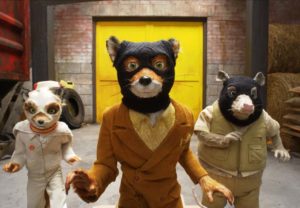
Ash (fox on the far left)

Ash is the same kind of fool and following practically the same line of examples as Bobby in King of the Hill. Palmer-Mehta sets Bobby up as a fool because he challenges the hegemony of the show and challenges traditional expectations. The examples from the article cite athletic ‘weaknesses’ or ‘abnormalities.’

Well, Ash has similar abnormalities as Bobby. He’s not athletic. He isn’t as good as his father at the game they play in gym class and he isn’t invited to steal chickens with his family. He is odd and strange because additionally, he wears a cape and spits when he’s upset.

Another way to think about this is that Ash is voiced by Jason Schwartzman, whom is always abnormal and challenges dominant culture or hegemonic ideology in his roles (especially in Wes Anderson films).

A Case for Kristofferson

Kristofferson in Fantastic Mr. Fox

He, like Ash and Bobby, defies expectations. He is called tall, which makes him weird and strange, when comparing him to the other foxes. Also, unlike Ash, he is athletic and is invited to steal chickens and cider with Mr. Fox.

However, this is where it gets tricky. He is unlike the others because he is actually gifted. Ash is seemingly bad at anything physical in nature; while Mr. Fox is bad because he frequently gets caught in his attempt to steal. This Kristofferson’s ability or natural skill, makes him different than the others and thus strange.

In both cases, Ash and Kristofferson, I believe they are natural fools, in that they “genuinely exhibit some type of deficiency or abnormality” (185). And they both break the dominant characteristics of those around them and challenge normality. Thus, to me, both characters could be considered fools.

ANIMATION BLOG 7: GENDER [MASCULINITY]

As I was reading “Post-Princess Models of Gender: The New Man in Disney/Pixar” by Ken Gillam and Shannon R. Wooden, I couldn’t help but think of the movie Wall-E. Gillam and Wooden suggest that Pixar movies, with their male protagonists, redefine masculinity via three maneuvers: emasculating the male protagonist, providing the male protagonist with a homosocial relationship/interaction, and then having the protagonist assume his new status as a “new man.”

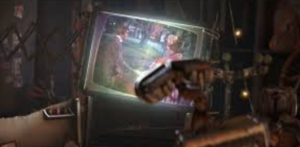
Wall-E, the robot, goes through this same trajectory in his film. First, Wall-E is established as an alpha male, much like Gillaim and Wooden track Lightning McQueen in Cars. Wall-E is introduced as masculine at the beginning of the film through showing his determination as he conducts his garbage collecting work. He is shown as being fast, efficient, and tenacious.

Wall-E stacks his compacted garbage cubes

Very soon, he experiences what Gillam and Wooden call the “emasculation of the alpha male” (3). As Wall-E is going about his trash collecting and compacting activities, a new being arrives on his desolate planet, and this new being, the female robot Eve, turns out to be magnitudes more aggressive than he is. Eve has lasers and attacks anything on sight, no questions asked. She is newer, sleeker, and more powerful than he is. She is new and modern, while he is obsolete and falling apart. He keeps spare parts in case he needs a replacement, within his personal collection (or horde) in his home.

He is emasculated not only through Eve’s status as being better and newer than he is, but by his loneliness. He begins the film as the only being on the planet. He has nothing in his life but his work and the objects that he collects that helps him pass the time. When Eve arrives, he sees the potential for companionship.

Wall-E has his own form of homosocial interaction. While not the homoerotic subtext of Mr. Incredible in The Incredibles, Wall-E’s instance of homosociality is his affinity for a musical. He finds comfort in the musical Hello, Dolly! frequently throughout the movie, with a particular attachment to the song “Put On Your Sunday Clothes.” In our homophobic and heteronormative culture, things like musicals and musical theater are associated with gay culture, so his attachment to this musical and this song further emasculates him. But, like Gillam and Wooden suggest in the article, his relationship with this song guides him towards his assuming a role as a “new man.” Gillam and Wooden say that “the intimacy emerging ‘between men’ is constructed through an overt and shared desire for a feminized object” (6).

Wall-E learns about love by watching Hello, Dolly!

By watching Hello, Dolly! over and over again, Wall-E learns about the importance of companionship, affection, and love. It teaches him socialization skills, such that he knows how to act when Eve arrives.

Finally, Wall-E fulfills the cycle described by Gillam and Wooden when he sacrifices himself at the end for Eve, exhibiting what Gillam and Wooden call an “express[ion of] care-taking, nurturing love, and a surrender to the good of the beloved” (6).

Thus, the film Wall-E becomes another example of Pixar’s mission of redefining masculinity, allowing children to see another path, another way to be, as opposed to the stereotypical alpha male, which has become problematized in today’s #MeToo culture.

BLOG 9: Film History

NAZIMOVA’S VEILS (Patricia White)

I started thinking about readings in the terms of ‘what kind of history is this telling?’ In the case of Patricia White’s chapter, it is approaching history from a biographical as well as industrial lens. Biographically, she details the life and career of Alla Nazimova. White obviously concentrates on Nazimova’s portrayal and involvement in the production of Salome, however she also talks about Nazimova as a person and actress. So, a major point of analysis in the chapter is Nazimova’s queering of Salome. Many film critics cited in the chapter talk about the weirdness of her production of Salome due to casting gay actors as well as her own identity as a lesbian. As a person, they discuss her in terms of orientalism, talking about her conflicting identities of being Jewish and Russian. Industrial-wise, White talks about Nazimova’s career as an actress and director. She also talks about Nazimova’s Salome in contrast to other productions of Salome. Finally, she talks about Nazimova’s Salome in terms of film history and film reception; noting that it wasn’t accepted as a hollywood film, but it could be appreciated as an avante-garde film.

MANHATTAN NICKELODEONS (Ben Singer)

This article was interesting to me because it talked about socio-economic research in film history. This article questioned the two common paths for understanding nickelodeon theaters. The traditional view was that only lower-income people attended movies because white collar and the more affluent were above going to the movies; while the revisionist view claimed that the middle class frequently attended movies. Singer’s article really shows what a complex question this is. I like that he approached his historical analysis transparently; that is to say, he was constantly revealing the caveats to any of his questionable findings. The key findings of the chapter are as follows: “The nickelodeon boom” wasn’t as much of a boom as commonly thought. In fact, many theaters failed. Singer suggests that nickelodeons had about a 50% chance of surviving the first year. He also questions the idea of a primarily middle class audience, if not completely obliterates it. Previous research was based on the analysis of four locations in Manhattan; which turned out to not be as middle-class as previous reports suggested. Many were working class neighborhoods with “lower white collar” workers, where white collar workers existed at all. He also found that the placement of nickelodeon theaters had to do with population density more than any other factor. They were located in populated areas with high foot traffic. The chapter does a great job at showing that this research question is not straight forward and requires extensive analysis of population data and business records.

CINEMA AND WIRELESS IN TURN OF THE CENTURY POPULAR IMAGINATION (William Boddy)

This article tackles the comparisons as well as contrasts between media in terms of research and reception. Most importantly, the article emphasizes the idea that a medium doesn’t all of a sudden pop up from no where. There are precursors and technological advances that lead to the big ones. For example, television rose from radio and photography. An interesting challenge Boddy brings up, that I hadn’t considered before was that cinema comes from a more privileged position due to the wealth of primary sources; while with early radio, recordings just don’t exist. Some of the readings from a few weeks ago that dealt with radio got me thinking and wondering why radio isn’t as researched; this chapter explained that question for me. In part, it’s a data issue.


“BEFORE SHE WAS A VIRGIN…” DORIS DAY AND THE DECLINE OF FEMALE FILM COMEDY IN THE 1950s AND 1960s (Dennis Bingham)

This article is interesting for two key reasons. First, I find it interesting the Doris Day herself dismantled her own image, by penning an autobiography to set the record straight. The autobiography tarnished her good girl, pure image and in it, she critiqued her own movies. Second, it is interesting by establishing her role in comedy. The article says that in her films she is considered a comedian or a funny woman, yet she delivers her funny lines straight and it is often the men around her who are funny, telling jokes at her expense.

VAUDEVILLE: THE INCARNATION, TRANSFORMATION, AND RESILIENCE OF AN ENTERTAINMENT FORM (JoAnne Stober)

In this book chapter, Stober discusses the history of vaudeville. She talks about the changes vaudeville experienced as an industry and art form, trying to legitimize itself and bring in higher clientele or more affluent audiences. However, what I found the most interesting was its connections with cinema. First, I found it interesting that vaudeville and cinema were linked as joint programs. And then, I was surprised to see that the coming of sound cinema is what brought the decline of vaudeville as “[t]he adoption of an all-filmic program meant that the live character once lent to the exhibition was vanquished, therefore rendering exhibition practices and programs seamless and homogenous from milieu to milieu and city to city” (143).

BLOG 8: BROADCAST HISTORY, PART TWO

GROOVE TUBE (Aniko Bodroghkozy)

This reading was really great. I flew through it. I’m going to have to get this book so I can read the rest of it. I really responded to her way of approaching history; she mixes her own personal account with a historical cultural analysis. The beginning of the article is about how she was fascinated by the idea of hippies based on the representation of them on television; but came to discover that the reality and the televised representation were two separate ‘realities.’

Chapter 1 was about how television created a counter-culture in the 60s. She starts out talking about Howdy Doody and how this particular show contributed to the hippie counterculture that pushed back against the baby boomer adults. Bodroghkozy suggests that Howdy Doody accomplishes this by showing children disrespecting adults and by featuring adult villains who were out to get the youngsters. The chapter also talks about how children of the 60s and 70s grew up much more quickly than previous generations because they had access to the reality of the world faster than previous generations. Television showed children/teenagers that adults were human and were capable, even prone, to making mistakes. Similarly, the television became a dominant location for children to obtain knowledge; which took some power away from adults and made children less subordinate. It covers how television showed the realities of life and the world to the hippie generation, which led to the counterculture of war resistance and anti-capitalism.

ONE NATION UNDER TELEVISION (J. Fred McDonald)

This set of readings from the book One Nation Under Television offered a historical account of the rise of television through a technological, industrial, and cultural perspective. In it, McDonald talks about key inventors, scientists, and business people who helped develop radio and television to make it popular; with a key focus on Sarnoff (for obvious reasons). McDonald also discusses the rivalries and partnerships between stations that influenced the technological development of television as well as impacted the regulations that surrounded it. I particularly found the spectacle surrounding the rise of television to be interesting; reading film studies books, they tend to emphasize the spectacle of film, but I’ve never read of the spectacle of tv until this book by McDonald. In it, he talks about the spectacle of touring television around the country so people could experience it. They would demo it in department stores and have live performances. A positive of this reading is it taught me a lot about the technical and industrial side of television that I didn’t know; however, I am much more interested in the cultural viewpoint, such as with Bodroghkozy’s writing.

THE MOUSE MACHINE (JP Telotte)

Oddly enough, what I found the most interesting about this reading was the stuff about the technology at Disney parks. The entire section about the Disney theme parks was incredibly interesting. It offered a viewpoint I hadn’t considered before (what goes unseen at the Disney parks in order to make them function in seeming perfection) as well as offered a viewpoint on Disney products that seemed accurate, fair, and not overly negative, which was nice to see. With all our readings in animation, I have begun to develop an extraordinarily negative viewpoint of Disney as a mega-corporation, however this reading shows that there’s a good side.

An approach that I found useful was when Telotte talks about how Disney parks are popular for people worldwide, even though it is a very Americanized phenomenon, that is to say, focuses on American products, ideals, and life. Yet, Telotte tells the story of fans from Denmark who go to Disney and can enjoy the parks whike “form[ing] and sustain[ing] their own cultural identities” and by exploring “what they see as being Danish through a process of contrastive validation to what they perceive as being American” (4-5).

The chapter about Disney and television was interesting because, at first, it convincingly discussed Disney in terms of it’s innovation and ability to adapt with changing media forms. But what I particularly found interesting was near the end of the chapter when Telotte talks about the science fiction/”science-factual” (112) programming. The thing that stood out to me was the obsession with accuracy. In adaptation studies, for example, fidelity isn’t typically considered a worthwhile path; however, when Telotte talks about Davy Crockett, fidelity becomes interesting. From the readings in animation, it has been a common theme that Disney has a history of backtracking. Yes, she’s latina; wait, no she’s not. Yes, she’s a princess, wait, no she’s not –for example. But with, Davy Crockett, first Disney approached the story with historical fidelity, but when they meandered away from that accurate historical account; and backtracked by saying they weren’t following the historical account, but the mythical, folkloric one. It’s fascinating how often Disney gets away with backtracking such as this.

RALPH, FRED, ARCHIE, AND HOMER (Richard Butsch)

This article talks about class representations in television; specifically how television frequently portrays blue collar men as “buffoons.” I feel like this article provides a cop-out. In it, Butsch provides the multiple reasonings as to why stereotypes such as this remain and occur as frequently as they do. Butsch talks about risk and how networks fear that which is different, so often similar series are developed. He talks about advertising pressures; that shows must keep their advertisers happy so they keep advertising with the station. He talks about the intense scheduling of creating a television show, saying how quickly series and episodes need to be churned out that there isn’t simply time to create more complex and unique characters because scrips have to be developed in a matter of days. He also talks about how repeated stereotypes makes casting easier. And, then, Butsch talks about audience expectations.

ANIMATION BLOG 6: GENDER [GOOD GIRLS, MOTHERS, BAD GIRLS]

Similar to my last blog (about Brode’s misguided portrayal of Disney), I have to disagree with the ideas posed by Joel Gwynne in “‘Might as Well be Dead’: Domesticity, Irony and Feminist Politics in Contemporary Animation Comedy.”

Gwynne’s article suggests that while animated sitcoms such as The Simpsons and King of the Hill present old fashioned stereotypes about femininity, they use them as critique. He claims that “[“Two Cars in Every Garage and Three Eyes on Every Fish”] illustrates the ways in which the domestic space can be modified as a location of empowerment” (62). In the episode, Bart finds a mutated fish with three eyes that he brings home. The mutated fish was a result of the toxic waste from Mr. Burns’ plant. Mr. Burns, while running for political office, has dinner at the Simpsons’ house, but before doing so, Marge is given rules to follow while Mr. Burns is there. These rules include things such as what she’s allowed to say and how she’s supposed to act. Basically, she is supposed to stick with easy, non-political small talk and she is supposed to just serve food. Gwynne claims that Marge subverts this seemingly oppressive situation by feeding Mr. Burns the three eyed fish, the mutant he is responsible for. When he can’t eat it, he assumes responsibility for environmental contamination and thus, does not win the election. Gwynne says she assumes agency in this episode by rebelling against her expected role.

However, like my problem with the analysis of the “feminist princesses” (Snow White and Cinderella), I have to also take issue with this analysis of Marge. This is not agency or empowerment, this is simply resistance. And the person resisting is the person who is not in power, thus the person without agency. She is still serving food. She is still providing houseWORK in the episode. It is not empowering agency, it is repackaged oppression.

Similarly, in the episode “The Marge-ian Chronicles,” Lisa signs up to be a part of a group selected to colonize Mars. Her interest in this project intrigues her family and everyone signs up to go as well. However, during training, Marge is fascinated by the technical manual that describes housework in the station.

http://www.simpsonsworld.com/video/666047043577

“Nutrition zone sterilization sequence,” Marge reads. “Oh! That’s just kitchen clean up! Fun!” She adds excitedly. Lisa tries to tell her that this is not fun but Marge says, “if you think of them as chores, they can be a blast.” Thus, in this episode, Marge is still assuming the role of caretaker and cleaner, even as she’s training for a space mission.


ANIMATION BLOG 5: Gender [Femininity]

Although I have found all of the readings from Douglas Brode’s Multiculturalism and the Mouse: Race and Sex in Disney Entertainment to be shockingly misguided (read: obscenely kind towards Disney and his legacy), the line I cannot get past without chuckling is: “As always, Walt stood with the rebels” (140). This is extraordinarily funny to me. Disney is nothing close to a rebel. He is a purveyor of dominant culture. Disney products (especially the media) are hegemonic objects. There is absolutely nothing rebellious about a single one of the animated features produced by Disney.

In “Our Bodies, Ourselves” Brode attempts to make the case that Disney princesses are feminists, especially Snow White, because, yes, they may enact traditionally subordinate feminine roles such as housework, they do it by choice (178). Essentially saying, no, no, Disney films aren’t sexist because the female characters aren’t forced to do housework, they choose to! They want to do it! The problem in attempting to reward Disney for his forward-feminist representation by saying his characters depict this new kind of feminism of choice ultimately lies in the fact that Snow White is choosing to do nothing, she is a fictional character. Thus, the dominant, hegemonic, white male culture of Disney is what is creating this ideology and these narratives.

When talking about how Cinderella is a feminist story, he discusses the working scene where the mice sing to Cinderella: “Cinderelly, Cinderelley….” In his discussion, he speaks about the organization of the mice. That they manage to get their required tasks completed because “[o]nly when a woman is in charge do men perform menial jobs properly” (187). The section of the chapter that attempts to empower women by saying, ‘look at how important Disney thinks women are, he basically says men are so incompetent that they couldn’t do basic housework without the help of a woman’; is completely ignoring the fact that the scene is completely about foregrounding the household oppression Cinderella suffers every day at the hands of the evil stepsisters.

Media: https://www.youtube.com/watch?v=ZOe6Nsf-KGA [YouTube video of “Work Song” from Cinderella (1950)]

Thus, Brode’s argument is horrifically problematic and comparable to issues with current feminism and the battle against “post-feminist thought”; that is problems in suggesting that we live in a world that the goals of feminism have been achieved. Women are portrayed doing housework because women want to do housework. Indeed, feminism still has a long way to go.

BLOG 7: BROADCAST HISTORY

The Social Construction of American Broadcasting: 1912-1922 (Susan J. Douglas)

Much to my surprise, I found this chapter very interesting. Having read Media and the American Mind by Daniel J. Czitrom and Tube of Plenty by Erik Barnaouw for MCMA 550 last year, I knew a lot of the beginning technological bits covered in Douglas’ chapter; such as the importance of amateur radio and the impact war and military use had on the technology. However, something that did stand out to me was the gendering of radio use. Operators and users were expected to be male and when it came time for war, the men were trained to become part of the Signal Corps; while women were seemingly only involved or trained enough so that they could teach the boys how to do their jobs.

I was surprised to see Douglas spend a page and a half entertaining occult and supernatural aspects of radio. Of course, Czitrom points out in Media and the American Mind that people both feared and were awestruck of the telegraph in the beginning due to its esoteric and occult nature; I find it interesting how with the introduction of new media, people find supernatural meaning to assign it.

My other interest in this article was the competing reasons people seemed to be interested in radio. First, it seems that people saw it as a way to learn and celebrate the differences of people throughout the country. Where someone could learn about a different region and a different way of life than the one they knew.

Then, the article turns and talks about all the ways radio was expected to unify and homogenize the nation through controlling the entertainment culture. Douglas talks about the potential (and preferred) used of radio to include: educational purposes (people could tune in to hear a Harvard lecture), musical performances (hoping for the broadcast of more high culture selections such as opera, instead of the popularly broadcast jazz music), better politics (more informed voters and more responsible and credible politicians), and religion (people could tune in to listen to sermons who could not attend actual services). This homogenization in the article is approached in a non-nefarious way that doesn’t seem as if Social Control was the goal; to turn the population into brainwashed masses. It did seem that these goals were to improve society and give people opportunities otherwise not available to them; however, these ideas when coupled with capitalism are easily muddied and abused.


Voice Over: The Making of Black Radio (William Barlow)

This packet of readings covers various aspects of black radio: from a survey of the history of “racial ventriloquy” and minstrel shows, to the business aspects of station acquisition such as governmental policies and regulations, to key figures in the history of black radio (such as James Brown, Stevie Wonder, and Cathy Hughes), and finally black public radio (including college stations, NPR, and community radio).

The most useful aspect of this reading, for me, was the introductory chapter that talks about minstrel shows. Many readings I have read over the last few semesters talk about African American stereotypes that are based on minstrel or vaudeville shows without much explanation of what these racist stereotypes mean. They are based on the idea that readers already know the characteristics of these stereotypes, so it has been hard to find that more introductory information. So, in that aspect, this chapter was invaluable because it provides the very necessary descriptions that I have been confused about such as the Jim Crow figure, Coon, and Interlocutor (2-4).

I also found it interesting that the racial ventriloquy went both ways: whites pretended to be black and African Americans pretended to be white. While, the first instance was purely in the name of mockery and oppression; the second example had to varieties, one to mock and one to allow them to fit in and acquire jobs they otherwise would not have access to.

Chapter 13 talks about the development of black radio ownership. Two staggering quotes from the chapter are in the first page: “The first two black-owned stations in the country were established in 1949” and “in 1970 only sixteen of the country’s eight thousand radio outlets were black owned.” 16/8000+, that is a shocking statistic. The chapter talks about key figures, movements, and media advocacy groups that helped changed regulations and policies involving broadcast ownership.

Chapter 14 describes key owners of black broadcast companies that helped pave the way for others. The chapter talks about James Brown, Stevie Wonder, Percy Sutton, and Cathy Huges. James Brown and Stevie Wonder are, obviously, musicians who bought stations. Percy Sutton was a lawyer who, as a child, dreamed of owning a radio station in order to “talk…about all the discriminatory things–about the injustices I saw all around me” (267). Cathy Hughes was a radio manager/producer turned professor at Howard University. She established a successful college station at Howard and eventually left and found her own success when running her own broadcast company, Radio One.

Chapter 15 talks about various forms of black public radio from college radio stations, to NPR, and community radio. Black public radio stations suffer from funding issues due to structural restrictions that determine what stations get funded/subsidized.


The Radio Reader (Michele Hilmes & Alexander Russo)

Hilmes’ chapter, Rethinking Radio, talks about the struggles radio studies went through in order to become a legitimate field of study. She talks about radio being swept under the cultural rug while film and television studies thrived. Film and television was seen as the mature media; while radio was seen as a defunct technology that acted as a stepping stone to get to the arrival of the paired-visual/audio media. Additionally, radio was seen as low-culture; film and television had ascended to higher culture status. However, in the 1980s, radio finally became studied in media departments. Hilmes notes, “radio now began to be perceived as part of the social glue that held America–and other nations–together” (10). She ends her chapter suggesting possible paths for the study of radio; paths including radio aesthetics and the everyday social function of radio.

Alexander Russo’s chapter, A Dark(end) Figure on the Airwaves: Race, Nation, and The Green Hornet, acts as a political analysis of the radio program The Green Hornet. The two most interesting maneuvers made by Russo in the article are discussing the political function of the show and its use of orientalism. Politically The Green Hornet functioned to critique excessive government power. Instead, the show “advanc[es] the argument that individual action, not collective action, is the best way to achieve these goals [redressing social ills]” (262).

The show invokes orientalism in several ways. The main character of the show is white and his sidekick is asian (first Japanese and when that becomes politically risky, they change his nationality); this sets up an automatic othering. Kato is other to Reid. By using this orientalism, it allows the writers to give Kato more mystical qualities associated with yellow peril (264). Thus, Reid has access to the hidden knowledge of the orient (through Kato) in order to fight crimes. In this way, initially, the show sets up an us versus them binary between Reid and Kato: Reid is western, Kato is oriental.

However, later in the show Kato’s orientalism is bifurcated. Kato is established as specifically not Japanese. Kato is asian, and thus not white, but he is also not Japanese; which distinguishes him from the real life enemy of America. Which, in essence, offers a situation of dual othering.

ANIMATION BLOG 4: RACE [Latino/a]

In “Starlets, Subscribers, and Beneficiaries: Disney, Latino Children, and Television Labor” Christopher Chávez and Aleah Kiley discuss latino/latina representation in Disney media properties. When thinking about the Disney animated feature Coco (Lee Unkrich, 2017) a few of their observations become extremely relevant. They are:

  • “Latinos have not been adequately represented either in front of or behind the screen” (2618).
  • “Latino representations on television are produced by large conglomerates with little equity in the Latino community. At best, these networks may develop programming with hired Latino help. At worst, they are creating programming with the help of producers who have little or no knowledge of Latino culture” (2618).
  • “Disney’s representation of Latinos and children of color from essentialized stereotypes to ambiguous hybridity. The new racially hybrid characters promote recognition for progressive inclusion while erasing serious realities about U.S. racial inequalities” (2619).

To address the first point: Although there are countless animated films (including those by Disney, perhaps especially including those by Disney), a majority of them focus on white, American characters. Few films focus on hispanic ones. Recently, only three examples come to mind, Coco, The Book of Life (Jorge R. Gutiérrez, 2014), and Turbo (David Soren, 2013). Of the three, only is The Book is Life directed by a latino animator; the other two are white men: Lee Unkrich is from Ohio and David Soren is Canadian.

The second point discusses that the companies who make these films and television shows are not from the communities they are trying to represent and thus take no steps to create a faithful cultural representation. In “Saludos Amigos and The Three Caballeros: The Representation of Latin America in Disney’s ‘Good Neighbor’ Films,” Karen S. Goldman talks about Disney creating representations of Latin America that exhibit inaccuracy. She observes, “while Saludos Amigos and The Three Caballeros were commissioned, in part, to dispel negative stereotyping of Latin Americans in Hollywood cinema, lose analysis reveals that the films actually promote other, no less inaccurate stereotypes, and, in particular, underscore the longstanding unequal relationship between the U.S. and Latin America. They continue to depict the flow of cultural texts from north to south as natural and unequivocal” (25).

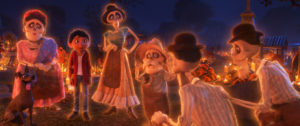
Within Coco, contradictory readings can be found. First and most obviously, it appears to be a celebration of Mexican culture. The film opens to introduce the audience to Coco’s family. A likable family that seems realistic, close-knit, and loving. The film introduces us to Mexican culture, including the Day of the Dead, Mexican music, art, beliefs, and value systems. They are a hard-working family of shoemakers. This pushes back against the harmful stereotype that Mexicans are lazy and criminals.

However, although the film welcomes us into this enticing world filled with a good, caring family; it certainly acts to Other the characters. The mythology and customs of the Day of the Dead take on extreme supernatural qualities. It deals with many of the real life customs, as described in Jan Thompson’s documentary film, Food for the Ancestors (1999), about the food customs around the holiday. However, Coco makes these beliefs and customs fantastical, which suggests that Mexicans are primitive people who subscribe to new age belief systems, beyond the rational world.To address the third point: Coco hybridizes its main character, Miguel. When he enters the land of the dead in order to find who he believes to be his ancestor, Hèctor (who amusingly enough is his actual great-grandfather) paints his face so that he looks more like a skeleton, allowing him to fit in. However, this act could also be read as making him appear more white and more Anglo-American. Hèctor paints Miguel’s face white with black rings around his eyes to make him look like a skeleton — or to make him white, and appealing to more audiences. Because, at this point, we have been introduced to him as a latino character in his own culture (this grabs the latino/a audience); by converting him to a white character, it then allows the white children to also identify with him and his quest.

              Miguel before his face is painted


After his face is painted

Coco, then, tries very hard to respect Mexican culture, representation, and talent — through its depictions and people involved in the project (production and talent). However, it still finds ways to reach out and include the white, American audience because at the end of the day, Disney/Pixar are companies out to make money and the more people you can reach, the more profit at the box office.

BLOG 6: PRINT MEDIA IN HISTORY

COMMUNICATION IN HISTORY (John B. Thompson and Ulrich Keller)

Thompson’s chapter talks about the development of periodical, printed news. Early news consisted of announcing events and conveying political news (113). He suggests that, initially, there four types of communication networks: (1) Religious networks controlled by the Catholic church, (2) political networks, (3) commercial networks, and (4) local networks (113). From the 14th through 16th centuries, communication was changed by the development of a post service and a printing service. Thus, printed news surfaced in the mid-16th century (114). He says that most early newspapers (or periodicals) focused on international news, so people could learn what was happening in other places. In the mid-1600s, newspapers (at least in Britain) began running local news stories. Early newspapers had to deal with censorship and tax issues, both were efforts put forth by the government to run newspapers out of business. Thus, the article describes the struggles of the original independent press (116). This makes the reader understand and appreciate what slow progress led to the free press we enjoy now.

Keller’s article talks about early photojournalism. The first news photographer is speculated to have been in the late 1800s, because earlier photography wasn’t an economical option. Keller suggests that photojournalism is an act of teamwork, as it involves the photographer, editor, and director (162). He identifies the Spanish-American war as the first war that was described in photographs (165). He says that most early papers still used drawings to illustrate their news stories (168). Like the previous article talked about the progress of printed communication, this article talks about the progress of photojournalism and emphasizes the technological determinism involved.


HOW MEDIA BECAME NEW (Lev Manovich)

Manovich opens his article describing the “media frenzy” caused by the invention of the daguerreotype. It first recorded architecture but then people wanted to be photographed by a daguerrotype. He notes that some early technology succeeded (like the daguerrotype) and some failed (like The Engine) (320). He also said that computers and modern media came about at around the same time (320). Mass society was dependent on machines: “Mass media and data processing are complementary technologies, they appear together and develop side-by-side, making modern mass society possible” (320). Mass media and data processing technology crossed paths with the development of cinema. The article focuses on tracking the development and crossed-paths of these two technologies.


THE BLACK PRESS (Robert S. Levine and Todd Vogel)

“Circulating the Nation” explores the development of the black press. Levine says that “Appeal” was the first series of articles penned by an African American that had massive influence (17). The series of articles instructed slaves to “kill or be killed” (17); calling for an uprising. By publishing the trio of articles, the author, David Walker, reached a national audience in print. Thus, Levine suggests that Walker’s articles in “Appeal” gave rise to the black press. Walker  [after “Appeal”] “came to understand the importance of print to the creation of a black nationalist consciousness” (21). He joined MGCA in order to fight against the group of people seeking to create a white nation, ACS. It was suggested to Walker that black people were not welcome. The ACS published a paper to forward this mission of creating an all-white country by sending the black people back to Africa. The black response to the ACS is a sort of oppositional reading as the ACS published how great Africa was in order to send the people they thought didn’t belong in the country, thus othering them; yet the black people used it to create a sense of community and pride. It became important for the development of a black press so that their ideas could be heard in opposition to the ACS (22). Thus, the Freedom Journal was born.

Levine identifies the importance of the black press by framing it in terms of Habermas’ “public sphere” — by saying, “[w]ithin Walker’s dialogical model, then, which is not all that different from Habermas’s imaginings of a productive and rational public sphere, black newspapers, and the Appeal itself, participate in a national conversation” (29). The importance of the rise of the black press is, of course, a matter of representation and acknowledgement. Making sure people get to speak for themselves and are able to build a community that allows for discourse.

Vogel’s article describes the role of the black press for “redefining their [African Americans] role in the nation” (37). It allowed the African American people to fight back against subjugation and marginalization and fight for their place in society.


NEGLECTED NEWS: WOMEN IN PRINT MEDIA (Maria DiCenzo and Leila Ryan)

This chapter talks about Women’s suffragist print media in the late 19th and early 20th centuries. DiCenzo and Ryan stress throughout the chapter that women’s print media had a dual role of first, talking to the general public to explain what  women were up to and were fighting for  and second, to rally the women together to keep them informed of the suffragist movement (239). They open the article by expressing their surprise that even though women were in the news and were making news that little attention has been paid academically to these types of publications in this time period. They say, “[t]hese print media are crucial to gaining an understanding of the scope and activities of a women’s public sphere at the turn of the twentieth century because they were instrumental in shaping opinion and establishing and mobilizing large- and small-scale activist networks and reform campaigns” (240).

An interesting goal of the chapter, I thought, was that they didn’t seek to examine the differences between the women’s publications at the time or how they differ from social reform publications of today; but were interested in finding the connection between these publications and similar ones of today. They also note that these publications are so important because they provide “articulation of feminist ideas through a range of print media came to influence attitudes toward women’s roles in public life” (240-1).

They also emphasize that these publications not only allowed members of the movement to have conversations with each other, but they established a “relationship with authorities and the general public” (246). Additionally, they say that these publications cannot only be thought of as propaganda, saying that such reductionism isn’t an accurate portrayal of these publications at all. Instead, they say, “alternative media [including these women’s publications] provide information about and interpretation of the world which we might not otherwise see and information about the world that we simply will not find anywhere else” (246-7). Indeed, they not only discussed issues directly related to the movement, but also general news items that related to women’s concerns such as the “women and children first policy” during the Titanic shipwreck.

Another interesting thing that I found about this chapter is that they suggest not viewing these alternative movements (such as suffragists) separately, but to consider them together “because such a move emphasizes their collective resistance to increasingly monolithic commercialized media systems…” (353).