Monthly Archives: September 2018

ANIMATION BLOG 3: Race [African American, Part 2]

COLOR THEM BLACK (Adilifu Nama)

Nama makes two very important key points near the beginning of the article. The first of the key points occurs when Nama’s talking about the author Junot Diaz’s childhood identification with Marvel’s The X-Men. Nama says, “because the group were mutants and were treated as social outcasts, as a young Dominican immigrant, Diaz felt an affinity for the characters due to his own marginalized racial status that stigmatized him as an outsider to mainstream America. Diaz’s experience speaks to the power of superheroes to deliver ideas about American race relations that stand outside of strict notions of authorial intent and draconian concerns about white superheroes (or black ones, for that matter) depositing negative notions about one’s racial identity into the reader or viewer” (pages aren’t marked, page 3 of the chapter). This speaks to me personally, not about race (so I won’t talk about it very long, as I understand this week is about race), because I, myself have an affinity for a comic book character because of parallels between the comic book (/film) representations and my real life. I have an extreme affinity for and empathy for the Marvel villain Loki. In the MCU, Loki is adopted and has a complex and problematic relationship with his family. I am adopted and have an extremely problematic relationship with one side of my family (stemming from my being adopted, actually). It’s important that Nama notes that feeling marginalized or otherwise Othered in some way in your real life can lead to negative identifications with fictional characters in the media consumed.

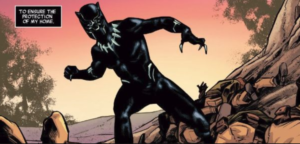
Secondly, of the 60s and 70s, Nama says, “[d]uring this period the bright line between the popular and the political was obliterated as American pop culture began to shred its escapist impulses and boldly engage the racial tensions that America was experiencing. For example, James Brown’s song ‘Say it Loud, I’m Black and I’m Proud (1968) did double duty as a dance hit and a racial anthem of uplift and self-esteem” (again, pages aren’t marked, but still on page 3 of the chapter). I believe this spirit cycled around with the release of Black Panther (Ryan Coogler, 2018), which is my chosen media for this week.

Here’s the trailer on YouTube: https://www.youtube.com/watch?v=xjDjIWPwcPU

I say this because with it, Marvel didn’t simply tell the same old origin story, as it is accused of doing in many of they’re movies; but it turned to politics. Black Panther is about race, it’s about colonialism, it’s about cultural appropriation — it is a complex movie about many political topics. This is relevant to a class on animation because Black Panther started as a comic, and does have many animated aspects in the film as well, although largely filmed as live-action.

Ultimately, it comes back around to representation. It is important for everyone to find images in media that they can positively and realistically identify with. Representations that are not built upon negative stereotypes that harm the communities that are being represented. Also, these comics (and film adaptations) provide a counter-cultural subversion that pushes back against systematic racism in order to offer a stronger element of social justice.


BLACKNESS, BAYOUS and GUMBO (SARAH E. TURNER)*

Was discussed in my previous blog post. 

Blog 4: Gender in Media History

THE HOUR OF THE CUCKOO (Melanie Bell and Melanie Williams)

This article talks about the woman’s film — first, historically; then, in relation to British cinema. At first women’s films are compared with weepies and melodramas. Bell and Williams say that women’s films focus on a female character, forward women’s concerns, and often replace intense action with the intense drama of a woman making a choice. Later, the article poses the question: is there a place for women’s films in British cinema? They ask this question because British culture is stereotypically uptight and unwilling to show emotion; stiff upper lip and all that jazz. However, they suggest that not only is there a place for women’s films in British cinema, but that British cinema has a long tradition of women’s films. They support this by discussing heritage films. They also identify common trends of British women’s films as connecting women and landscape and films with ensemble casts. As someone who often dismisses chick-flicks or melodramas as boring fluff, I was shocked to read that some of these British women’s films rank higher in popularity than Harry Potter and James Bond (7). The article stresses that women’s films are not only that; women’s films exist within multiple co-existing genres.


CHANGING MEDIA HISTORY THROUGH WOMEN’S HISTORY (Susan Henry)

At first the article made me quite angry. I wondered how such statements could be made by a woman. The beginning of the article made it sound like — yes, there has been much research on women in mass media and it is solely due to the fact that men have supported and encouraged it. Luckily, that infuriating tone changes on page 40, when she starts talking about new approaches to women’s history in media studies. The problem, Henry suggests, is that women’s media history has been done within the same framework as male media history. This lens rewards autonomy. However, in the following sections, she emphasizes the community and collaboration that is important not only in women’s communities and relationships but in journalistic enterprise itself. She lists five methods that could be explored to expand the knowledge of women’s media history: women’s culture (43), women as community builders (45), women’s formal and informal connections (46), women’s work (48), and women media audiences (49). In her conclusion, she says that perhaps these pathways won’t lead to significant paradigm shifting breakthroughs, however it will offer more complete knowledge, and that is important when thinking about history.


INTRODUCTION TO A FEMINIST READER IN EARLY CINEMA (Jennifer M. Bean)

This article discusses feminist methodologies and lenses for the analysis of early cinema. However, what I find most interesting about the article is the debate of early cinema. First, Bean suggests that the 1917 cut-off line for early/classical cinema as establishes by Bordwell, Thompson, and Staiger in The Classical Hollywood Cinema (1985) as arbitrary. Then, she introduces the chapter written by Zhang Zhen which describes early cinema in different terms: “‘the term ‘early cinema’ (zaoqi dianying) serves loosely as a common reference to the cinema before 1949, when the Communists drove the Nationalists to the island of Taiwan and founded the People’s Republic of China on the mainland.’ Zhang joins recent Chinese scholars in making ‘finer periodizations within that long ‘early’ period,’ and does so by placing the Shanghai industry between the 1910s and 1930s in conversation with issues of gender and modernity that Western scholars have brought to bear on early Euro-American products” (11). Although I understand that dominant film criticism/theory/history is very Westernized (read: Americanized), I rather naively accepted Early Cinema/Classical Cinema separations to be universal. This alternate (international) viewpoint was a much needed wake up call for my view of film history. Bean’s introduction suggests five methodologies for analyzing pre-sound cinema: “authorship, spectatorship, historical topicality, stardom, and periodicity” (14).


COMIC BOOK MASCULINITY AND THE NEW BLACK SUPERHERO (Jeffrey A. Brown)

Brown’s article is about representation of masculinity, specifically black masculinity in comic books. The article does a good job of problemizing binaries: black/white, masculine/feminine, body/intelligence, etc. He criticizes the common image of masculinity in comic books: white and hypermasculine. He points out that the dominant narrative of superhero comics is to give the hero a duality: he is wimp and hero in the same person. When he is in his “regular life” like Clark Kent, he is a wimp. However, Superman is hyper masculine with unrealistic physical proportions. He also discusses how this taps into stereotypes of black men being physical and aggressive. Thus, black superheroes could convey too much masculinity. The comics he highlights in the article, published by Milestone Comics, offer superheroes within realistic measurements as well as intellectual capacity. The article very much shows why representations beyond the dominant culture (white men) are important.


THE HOUSES OF HISTORY (various readings)

The theme of this packet of readings is best summed up in a statement made on page 253: “Knowledge of history is knowledge that thing have changed and do change.” This plays out in this first chapter (chapter 1o) by explaining that over time it was understood that considering gender alone was not enough. Although not calling it by name, the chapter calls for considerations of intersectionality, in that suggesting gender, race, and class be considered in addition to other characteristics such as religion, disability, and sexual orientation (256). Change is evoked in the following chapter about colonialism, when post-colonial studies are discussed — talking about subalterns (here, colonized countries) telling their own stories instead of allowing their histories to be told by the colonizers. However, change is most strongly emphasized in chapter 12, talking about post-structuralism, post-modernism, and deconstruction. In this case, histories change as new information and new interpretations are collected. This chapter offers a great analogy that helped me more fully understand the idea behind structuralism and post-structuralism. In the chapter, they are described in terms of making a house: “Each historian, while not able alone to see the full picture, both due to lack of evidence and an inevitably subjective interpretation, contributes her brick. Eventually the house will be finished, and the person lucky enough to add the paint to the front door knob can stand back and see the completed whole” (298) [an analogy for structuralism]. Then says, “[a] poststructuralist might argue that the house is still only visible from one side; for all the observer can tell, the far wall may be unfinished; as the observer walks to the back door, the front porch may collapse” (298). I found this house analogy to be very helpful.
Blog 3: The Challenge of Media History

The readings this week describe the various challenges of conducing historical media research. Uricchio’s “Historicizing Media in Transition” opens and closes with referneces to Herodotus. Uricchio describes the Heredotus story as one of decentralization: “[Herodotus’] encounter with Egypt, its history, customs, and inhabitants, produced an epistemological vertigo of sorts… [He] was confronted by the inescapable realization that not only was Greece not the center of the civilized world, but that Egyptian civilization, evidently thousands of years older, had provided the Greeks with the elements which they took to be identifying marks of their own civilization” (23). The article addresses the commonplace practice of conducting medium-specific histories and calls for a multi-faceted approach to media histories.

James Carey’s “The Problem of Journalism History” suggests that the problem is they way in which journalism history is conducted. He says that journalism history is often “dull and unimaginative” (3). He notes the lack of exploring the cultural history of journalistic reporting. He says that journalism is not static, but ever changing.

“Early American Film” by Tom Gunning shows the different ways in which a film historian can approach research and also that different approaches can develop different conclusions. Most notably, he shows that different conclusions can all be true, which fights against the idea of a grand narrative. The way in which he really emphasizes this idea is when he discusses the different theories of the classical system. In this analysis, he summarizes the work of different scholars who all see different things as separating early cinema from classical cinema. For example, Noel Burch separated the two via IMR and PMR — institutional mode (Hollywood film) and primitive mode (underdevelopment of early cinema). While Kristen Thompson separates the two by saying the classical cinema focused on storytelling.


Briggs and Burke say that “media need to be viewed as a system, a system in perpetual change in which different elements play greater or smaller roles” (4). In this article, they suggest that there is no initial starting point that a historian can fall back on to begin their analysis of communication history: when does one start? The invention of the alphabet? Printing? Radio? The interesting point made by Briggs and Burke is that history and communication (media) cannot be separated. This point is supported via an excellent analysis of the media’s role in the Afghanistan/Iraq war. One cannot tell the story (history) of what happened without a discussion of the media.

“Things that Shape History” by Giorgio Riello was an exciting article to read because it offered three methods of exploring histories of material culture: history from things, history of things, and history and things. It goes through three case studies that show how each of the three methodologies are practiced. While “The Case of the Missing Footstool” by Glenn Adamson is an entertaining analysis of how one can study things that are absent. In the article he makes the case that the things that are absent from historical record are just as important as the things that are there.

ANIMATION BLOG 2: Race [African American]

The chapters by Willetts and Goldman in Diversity in Disney Films discuss racism. The opening of Willetts’ chapter says begins: “[t]here is little doubt that for the young and young at heart, Disney is synonymous with magic and fantasy, a wish factory if you will. It is an alternate universe that operates at the pleasure of young children, centering their world view, creating a place where animals speak, one never grows old and the possibility of becoming a prince or princess seems far more attainable than becoming a scientist or teacher” (9). Of course, the rest of the chapter is dedicated to emphasizing that this wish factory is for only certain children — white (middle and upper class) children. Also discouraging is that which goes unanalyzed: the idea that it is easier to become a princess than a scientist.

Willetts goes on to describe how Disney portrays its racism — often characterizing African Americans as primate-like creatures, such as through statements such as: “[i]rrespective of the manner of portrayal the intent was the same: to illustrate the differences between the races, thereby validating the notion of Africana people as direct descendants of ‘the missing link,’ more closely related to primates in ancestry, appearance and behavior than humans (Europeans)” (10). Depictions often set black and white characters into opposing depictions — whites were “good, pretty, [and] intellectual” while black people were “bad, ugly, [and] emotional.”

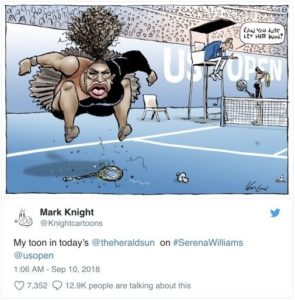
Above, is my  chosen media for the week. I chose it because it directly engages the concepts of the readings for the week. This cartoon is from September 10. It is a cartoon drawn by an Australian artist, depicting Serena Williams’ breakdown at the US Open. This cartoon immediately went viral and the artist’s response was that it had nothing to do with race or gender; yet, anyone looking at it can obviously see the cartoon is very much about both. It particularly deals with the concepts Willetts addresses in “Cannibals and Coons: Blackness in the Early Days of Walt Disney.” Serena’s features are featured exactly in the terms specified in the chapter. She is depicted as “bad, ugly, emotional, [and] savage” (11). Her features in the cartoon make her appear more ape-like than human. The cartoonist exaggerates her features, making her appear more masculine than feminine. She is drawn ugly. Her behavior in the cartoon is coded as bad, emotional, and savage. In the cartoon, she is having a full-blown tantrum; whereby she’s jumping up and down into the air while screaming after breaking her racquet. While her white opponent is drawn to appear like an actual human being and in complete opposition to how Serena is drawn. She’s thin, blonde, and has appropriately drawn features. Her opponent is standing still, calmly speaking to the line judge.

Goldman’s chapter on Disney’s “Good Neighbor” films discusses how these films were produced in order to bridge international relations. However, in reality they followed and further forwarded stereotypes of Latin America that continue on into contemporary animation.

Sammond’s chapter on race in animation talks about the white-black racism in early cartoon shorts. The most interesting exploration in the chapter are the bits involving minstrel characters, the most well known and most talked about example being Mickey Mouse.

Finally, Turner’s chapter “Blackness, Bayous and Gumbo: Encoding and Decoding Race in a Colorblind World” uses Stuart Hall’s work to discuss the opposing readings of The Princess and the Frog. In her chapter, Turner explains that the film was the first to feature black characters since the extremely controversial Song of the South. The article ends by saying that The Princess and the Frog was in a situation where it couldn’t win. That is, “[f]or some it will be too Black, for others not Black enough” (94). I tend to wonder if it would have been placed in this can’t win situation if Disney had incorporated more diverse characters throughout its history of films.

Animation Blog 1: Race [Asian]

ANIMATING RACISIM (Brian Behnken)

For me this entire article makes me completely reconsider the media of my childhood. As a child, I loved watching Tom and Jerry, Popeye, Speedy Gonzales, and Merry Melodies. Upon reflecting back on some of these as I was reading this article, I realize how immensely racist they were — they would replay many of the animated shorts from the 1940s and 1950s during the 1980s. It would appear that at this time, anyone that wasn’t a white male (like the creators) were viewed as other and depicted that way in their cartoons. A particularly shocking part of the reading occurs on pages 87-88, when he describes the shorts attempting to make the horrors of the KKK humorous.

Silly Symphonies [Egyptian Melodies]: https://www.youtube.com/watch?v=L1j7uhwDGsc&t=104s

Mickey in Arabia: https://www.youtube.com/watch?v=AkYCMMXiqhw

The two above Disney shorts are engaged with the othering discussed in the Animating Racism chapter. The shorts other both groups of people by parodying the stereotypical aspects of their culture that Western people think of. A couple examples of this are by associating Egypt with mummies and Arabia with jars and snakes. The short Mickey in Arabia also deals with issues of orientalism as discussed in Leslie Felperin’s chapter on Aladdin.

The Siamese Cat Song [from Lady and the Tramp]: https://www.youtube.com/watch?v=Ly_vxI4nllA

The representation of the asian siamese cats in Lady and the Tramp follow the same offensive stereotypes outlines by Behnken. They feature slanted eyes, over the top accents, and are portrayed as being shifty and mischievous. Also, their song features the sounds of gongs and stereotypical asian instrumental music.


The stereotypical, racist representation follows along with Behnken’s article as in addition to slanted eyes, the asian cats are drawn with big front teeth and their whiskers function as a pseudo-fu manchu mustache. Dare I say the coloring of the cats seem to be tinted yellow, presenting an example of subtle yellow-face.

RESURFACED MIKE PENCE OPINION PIECE ABOUT MULAN…. (Jonna Ivin-Patton)

This short article is ridiculous for so many reasons. Well, the article itself isn’t the ridiculous thing, the statements made from Pence are. From what I know about Pence through the last presidential election and the news coverage of his VP endeavors, the level of short-sightedness and sexism evident in his statement shouldn’t surprise me, but it staggers me all the same. He says, “[h]ousing in close quarters, young men and women (in some cases married to non-military personnel) at the height of their physical and sexual potential is the height of stupidity…. Put together, in close quarters, for long periods of time, and things will get interesting.” This statement suggests that women (perhaps human beings in general) are similar to animals. As if people have no self control and more absurdly, as if every woman would find every man attractive (and vice versa). His viewpoints on the interactions between the sexes and indeed the capacity of women is extremely outdated.

THE THEIF OF BUENA VISTA (Leslie Felperin)

This article talks about how Aladdin is engaged with orientalism (as defined by Edward Said). That is to say, that Aladdin doesn’t offer a representation of the orient as it exists, but as the occident (the West) has assigned to it. In order to keep them as other (and thus inferior to Western ways, ideals, beliefs, etc.) the West represents the orient as a magical wonderland instead of a land of reason. Again, I found something that shocked me. I was surprised to read that the sources that the Disney designers turned to while producing Aladdin came mostly from the West. If you were going to portray a culture in a movie, wouldn’t you turn to what that culture says about itself instead of what the West says it is?

BLOG 2: The Nature of History

HISTORICAL METHODS IN MASS COMMUNICATION (James D. Startt & Wm. David Sloan)

The first chapter outlines and discusses the three elements of historical research : evidence, interpretation, and narrative. Evidence is merely your data. Interpretation involves “history as the reconstruction of the past…. reconstruction as an interpretive act” (3). That is, after the researcher gets the data s/he must interpret the story that fits the data. Narrative is the fact that historians have to tell a story. After that the chapter gets into the debate of if history is a social science or a humanities discipline; certainly it can be placed in either category as “history is sometimes perceived as in part one of the humanities and in part one of the social sciences since it contains elements of both art and science” (10).  The last section of the chapter explores the purpose of history: to tell events of the past with truth. They note that “historical time” is an important consideration, as events happened at a certain time and place and understanding that place and context within the time it actually happened is important because meanings change throughout time.

The second chapter is about history as an interpretive act. It opens with a discussion about how history is more than just recalling dates and telling what happened, it is about explaining what occurred. They list different schools of thought/stages of historical research/perspectives: nationalist school, romantic school, progressive school, consensus school, and cultural school. The nationalist school “looked on the history of America as the advancing relation of the nation’s leadership role in mankind’s improvement. To them, America was the nation chosen to lead the world to the fulfillment of mankind’s destiny: greater freedom and liberty” (22). The romantic school followed the same nationalist viewpoints as the nationalist school, however they were novice historians. The progressive school were impacted by positivism and “began to think of history as a science rather than as an art” (29). “They believed the primary purpose of the media was to crusade for liberal social and economic causes, to fight on the side of the masses of common, working people against the entrenched interests in American business and government” (29). The consensus school thought that American was based more on agreement than conflict and that its population was more united than divided. “Consensus historians generally approached communication history from the viewpoint that the media should work with the public and government to solve problems rather than create divisions by emphasizing problems and conflicts” (32). The culture school believed that the media and their culture were connected: the media influenced culture and the culture influenced media.


THE NATURE OF HISTORY READER (Eds. Keith Jenkins & Alun Munslow)

The important aspect of this reading is the outlining of the key positions one might take as a historian: reconstructionism, constructionism, deconstructionism, and endist. Reconstructionism is about getting to the truth about what happened. Constructionism considers theory (such as critical theory concepts that take social, power, political, and cultural aspects into account). It focuses on social history “because of the appeal of its key organizing concepts — class, feminism, gender and race” (81). Deconstruction breaks down previous approaches and is open to multiple perspectives. Endisms seem nihilist and pessimistic; addressing questions of if history research is dead or unimportant.


PERSPECTIVES ON MASS COMMUNICATION HISTORY (Wm. David Sloan)

This reading at first rehashes a lot of the material found in the Historical Methods in Mass Communication selection (not surprising, as they were written by the same author). It lists again the different ideologies (schools, approaches) and then talks about interpretation in historical methods. He talks about the values and problems with using interpretation. The second section of the reading explores the exploration of truth in historical research. He opens the section/chapter with: “Let us begin with a statement of fact: The study of history is one of the most important dimensions of modern thought…. It is worth remembering, however, that the scholarship associated with it is among the best and most vigorous of any field of learning and that it contributes to the well-being of contemporary life” (14). Some roadblocks to the truth that he’s identified include historians coming to conclusions prior to having read/gathered the full record of available information, privileging  the narrative interpretation over the collected facts, and by skipping past the primary sources and relying too heavily upon secondary ones.


HISTORICAL THEORY (Mary Fulbrook)

The thesis of this book seems to be the destruction (or criticism, if put more nicely) of the concept of “True Stories” or the obsession with “Important Facts about Things Which Really Happened” (3). She also stresses the importance of theory and history; much of the readings so far have seemed to push away theory (some overtly trivializing its use). Fulbrook embraces it. She says, “the very plurality of approaches in history suggests that there is in fact no single disciplinary approach: that ‘history’ actually only refers to the subject matter — that which has gone, the past — and to a distinctive set of theories and methodologies” (7). In her discussion of Holocaust history, she notes that different historical analyses are possible when using the same data and multiple results can be equally valid (8). By summarizing research by Kershaw, Fulbrook shows how by researching and re-researching and telling new (old) stories of the Holocaust has greatly changed and strengthened our understanding of Hitler’s role in the Holocaust (115).

Blog 1: Intro — History and Historiography

THE WRITING OF HISTORY (Michel de Certeau)

This article discusses the challenges of conducting historical research in order to find meaning. Certeau talks about the problems with making meaning of religion by historical methods, pointing out that theology is “religious fact, and it is a fact of doctrine” (19). Overall, this article discusses the challenges of historical research. Approaching a historical event or belief from a different viewpoint can yield different results. When we seek to understand a historical event, we myst take into account the object of study but also the time/culture in which it occurred (34).


WORKING IN THE ARCHIVES (Various)

This set of articles deals with the practical nature of conducting archival work.

The first article talks about hidden versus digital archives. Ramsey discusses the different types of archives — processes and accessible, hidden, and digital. Hidden collections are those which have not been processed due to funding or staff issues. Processing can be delayed for months or longer. Knowing what collections your institution has is important so that you can let archivists know you are interested in holdings — perhaps this could fast track the processing of the collection you are interested in — but perhaps not. Priority is given to collections that attract interest. Digital archives digitize items in the collection which makes them easily accessible to more people. Of course, this can be seen as a less intimate interaction with archival material. However, it keeps them preserved.

Tirabassi’s article discusses the technical aspects of archival work. She narrates what it is like to be in an archive — interesting for me, as someone who’s never been in an archive. She talks about considerations and challenges of archival work, including the necessity of out-of-the-box thinking required at times to get the information needed for a research project. Items are categorized and defined by an archivist. They cannot anticipate every interest and need of each researcher who might come in and use the collection. She defines four principles she has developed for archival work: principle of selectivity, cross referencing, categorization, and closure. She stresses that there comes a time when you have to walk away in order to actually write up your research; although you will never feel done, there is always another document to read or another lead to follow.

Ritter’s article talks about a gendered nature of her archival work. She was looking at remedial courses of English at Yale in the early 20th century. This involved men teaching boys and it is obvious the whole thing occurs within a masculine space, no girls allowed. She even wonders if she was the only woman to read the documents in the collection. Challenges she faced initially involved trying to locate the information she wanted about the remedial classes. At the time, they weren’t called remedial classes, so she had to be creative and investigative to find the documents she wanted. For me, the shocking part was how the English program was so defined by gender. She talks about a picture she found and how those men made the English department. Teaching at girls’ schools was seen as a step down in their career.


POETIC LICENCE AND THE INCARNATION OF HISTORY (Atom Egoyan)

This article discusses the expectation of historical fact in historical movies. James Cameron’s Titanic is the main communicator of information about the shipwreck for an entire generation of people (my generation; the only time we ever talked about the Titanic in school was in relation to Cameron’s film. It was certainly not a part of the curriculum). People learn about wars via war movies (Saving Private Ryan, for example) or understand what happened in the Holocaust via Schindler’s List. Egoyan made a film (Ararat) about the Armenian genocide. “In making Ararat, I wanted to show how the truth is not to be found in the epic scenes of deportation and massacre, but in the intimate moments shared by individuals” (18). Egoyan’s film is surrounded by a culture of denial that the genocide even took place; it was meant to shed light on a horror that was systematically covered up.


A SHORT GUIDE TO WRITING ABOUT HISTORY (Richard Marius & Melvin E. Page)

This book provides an overview of how to conduct historical research. They give tips about choosing a topic and narrowing it, caution against common errors (do not plagiarize), and provide excellent writing advice. I particularly found the advice about linking the first and last paragraph of your paper together helpful; introductions and conclusions are the most difficult parts of writing a paper for me, so this practice might help me out greatly.